
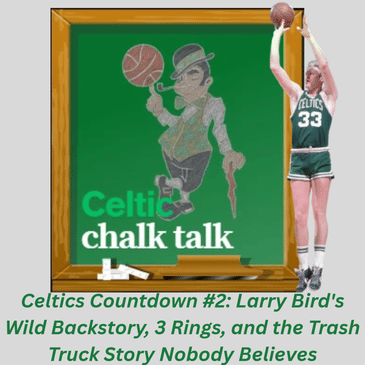
Steve continues his Celtics Countdown series with the No. 2 pick on his all-time Celtics list: Larry Bird. From a legendary trash-talking moment at the All-Star three-point contest to the garbage truck detour that nearly kept him out of Indiana State, Steve walks through the full arc of Bird's career — three championships, three MVPs, the Bird-Magic rivalry that helped save the NBA, and the front-office success he never got to have in Boston. Before diving in, check out more from the network at https://thepeachbasket.net/ballmer/.
00:00 — Intro and a quick word on thePeachBasket network
01:00 — Setting up the No. 2 pick: Larry Bird
02:00 — Bird's underrated defense and the All-Star three-point contest trash talk
03:00 — Career accolades: Rookie of the Year, AP Athlete of the Year, retired No. 33
04:00 — French Lick roots, the Bob Knight recruitment, and the garbage truck story
05:00 — Indiana State's run to the title game against Magic Johnson and Michigan State
06:00 — Boston drafts Bird, and his rookie-year turnaround
07:00 — The 1981 title, plus the additions of Kevin McHale and Robert Parish
08:00 — The trade for Bill Walton and the 1986 championship run
09:00 — The 1987 Finals loss to the Lakers and McHale's broken foot
10:00 — Career decline, retirement, the Pacers years, and Bird's legacy
Celtic Chalk Talk - 9-21-2026
===
Steve: [00:00:00] Welcome to Celtic Chalk Talk. My name's Steve Purciello, lifelong Celtic fan. Go back to the Bill Russell days, could tell stories, which I try to do a little bit on this site. Before I begin, I just wanna mention a couple things about the Peach Basket. thePeachBasket.net, one word, peach ba- thepeachbasket is a website that has collaborators like me who all have very, we're not affiliated with anybody. We love basketball, and we talk about it, we do pods, we write about it, and, and we show highlight films or different things on the website. If you really like this podcast, or even if you don't, just check out, check it out, check out the website, check out our pods. You will find different people with different views, as well as talking about different subjects from the NBA.
And I think you'll find it enjoyable because again, there's nobody paying us. We're doing this [00:01:00] out of the love of the game, and we enjoy talking about it. Now, let's talk about my number two selection in my top 10 all-time Celtics, and it, it's it's not an easy choice, but it is a choice that I think is the right choice.
It's Larry Bird. I can read, I'm gonna read his achievements and compli- accomplishments, and they're numerous, and this is just, you know, with the game of basketball. He's a three-time champion, two-time finals MVP, three-time NBA MVP in the regular season, 12-time All-Star, All-Star game MVP nine-time NBA first team, one-time second team, three times All-Defensive second team.
And let me give a little background on that. Larry Bird was not a great straight-up defender, but one of the best help defenders in the league. He would steal, he would, he would ... Just did so many different things on the defensive end to help his team, though [00:02:00] he didn't have the quickest feet in the world and wasn't a great straight-up defender.
But that tells you the respect for him. He was the Rookie of the Year. He was the three-point champion three times. Everybody knows the story, and I'll tell it now. When Bird One year he came into the locker room, everybody was nervous, of course, before the three-point shooting competition in the All-Star game.
Bird looked around the room and said to everybody, "Who's coming in second place?" Naturally, Bird won that, but, but just the, the chutzpah to do that and just i- it, it's incredible, and it tells you how great he was. Larry was just incredible. He was the AP Athlete of the Year. He is, of course, on the anniversary team and the 50-year team and the 75-year team, and he'll be on every team forever.
He the number's retired, number 33. In, in a little different thing, '79, he was the college basketball player of the year. [00:03:00] Two-time All-American. And now after that, after the NBA career, he worked with the Pacers. It's a regret that he didn't work with the Celtics, but with them, he was the coach of the year in '98.
He only coached for three years and did a great job, got his team to the finals, the Pacers. And then he was the executive of the year 'cause after he left coaching, he stayed with the Pacers as an executive and won that as well in 2012. Of course, a Hall of Famer and he also is a member of the Olympic Dream Team.
I mean, what, what a career. Now let's start at Larry Bird grew up in, in French Lick, Indiana, played basketball, was a really good player, recruited by the University of Indiana with a guy by the name of Bob Knight bringing him there. It didn't work. Bird was not ready for, for that type atmosphere. He lasted a little over a month, went home.
The story goes he, he worked for garbage-- on a garbage truck, did that for a while, and Bill [00:04:00] Hodges, the assistant coach at Indiana, was relentless in ch- trying to recruit him, and finally Bird decided to go to Indiana State. At Indiana State he was great. His, his last year, he took a team that wasn't real good to the finals.
They lost to Magic Johnson and Michigan State. Now, what's ironic on that is Magic and Larry Bird are the two guys, and they had a rivalry at that time. Now they're friends, but they had a rivalry. Those two guys really saved the NBA. If you follow the NBA and know a little bit about the history, you know that in the '70s, the NBA was in a dark time.
Drug problems and, and all the other things that go with it tied the NBA down By the time Bird and Magic came along, they played a game that was highly rated, Indiana State, Michigan State College Basketball National Championship. Highly rated, everybody wanted to watch this guy, Larry Bird, [00:05:00] and Magic Johnson.
Anyway, Indiana State lost. His-- Bird didn't play well. His-- There was stories that he hurt himself, his hand, that he was having trouble shooting, whatever, but Michigan State won the game. Both of them go on to the pros, and they really, in the '80s, they rescued the NBA to be honest with you. Now, before Bird got to his senior year, the NBA had a little rule that if your four-year class is done, you can be drafted.
Bird, because he went to Indiana the first year but really didn't play and didn't go, he had a fifth year of eligibility coming. Boston, Red Auerbach, brilliant as he is, decided to select him. They took him in the first round, the sixth pick, which Boston had. Now, Boston was going through rough times then.
They-- Bird did not play that next year. He stayed at Indiana State, but Boston signed him after that. [00:06:00] Now, Bird then becomes a Celtic. Now, his first year with the Celtics, this is, tells you the, the greatness of him. Boston won 32 more games than they did the year before, and Boston did well, got beat in the playoffs by Philly, I believe.
But then by '80, the next season, Bird and the Celtics came back from down three to one to Philly in the finals and beat... In, and, and in the conference finals and then won the title. That was the first of his three titles in '81. Also that year, they brought in the Celtics were able to bring in Kevin McHale and Robert Parish, it made it a heck of a lot easier.
Now, Bird continued just being great MVP and all those good things. It was incredible. By '84, now Bill Fitch was the coach up until '82. Boston just didn't feel, or '83, they didn't play. They didn't play [00:07:00] anymore. They got swept by the Bucs. So Fitch gets fired. K.C. Jones becomes the coach. '84 playoffs, they're playing the Lakers.
Great to see the Celtics and the Lakers squaring off. And in that series, that is the famous where McHale clotheslined Rambis M- Bird derogatorily said about his teammates that they weren't-- they were not tough. McHale clotheslines Rambis, turns the playoffs around. Boston ends up winning in seven, finishing it in Boston Garden.
It's his second title, but bigger than that, they beat the Lakers. The Lakers were always the team that Boston beat. So now we move along to '86, and this gets interesting. In '86, Red Auerbach had had enough of Cedric Mashwell, Maxwell, and wanted him out. He had some knee problems and different things and, and anyway, he wanted him out, and he traded him.
He traded him for [00:08:00] Bill Walton. Walton came in, was the sixth man of the year and was tremendous. There's a story that's out there that Walton dragged a bunch of Celtics, everybody but Ainge, I believe, to a Grateful Dead concert. I mean, that was the impact of Walton on the team. Bird and Walton got along great.
And Boston, this is one of the probably three, two or three greatest teams of all time. In '86, Boston won the title. They beat Houston 'cause the Lakers were beaten earlier, so they beat them in six games in the finals. So that was Bird's third title. In '87, Boston got to the finals, but lost they lost to the Lakers.
That was the first time the Lakers could beat them. But in that, in the '87 season, that's when Bird stole the inbounds pass against Detroit and fed Dennis Johnson, who made the layup, and Boston won that game. Stole the game really in the last seconds. They went to the finals. They lost [00:09:00] to the Lakers in six.
Kevin McHale played that series with a broken foot and really still has trouble getting around. He, he's got a little hitch in, in his in his movements. But that was the '80 '17. Now from that point on, Boston decreased each year. They got a little, little worse each year. By By, by '92, Boston was still decent.
They were playing Cleveland in the fi-- in the in the conference semis, and they lost in seven or six to them, six I believe, but they lost to them in Cleveland and they got knocked out of the playoffs, and Bird retired after the Olympics in '92. That was the end of his career. But there's more, as there always is.
Bird then the went on, he never worked for the Celtics, which is a regret. I think the Celtics made a mistake. They should have hired him instead of M.L. Carr in the ni-- whatever, after he retired [00:10:00] as the general manager. But Bird went on and coached the Pacers, coached them for three years, was coach of the year one year, brought them to the finals with Reggie Miller.
Then he stopped coaching. He believed coaches only needed three years, and that was it. He stopped coaching. He became an executive with the Pacers, and the Pacers continued to do well throughout Bird's time, and Larry Bird then became executive of the year in 2012, retired left, left the game, left the scene, and still around, but not, you know, as often as he should be.
In my mind, Larry Bird is a top 10 player of all time, and that's saying something 'cause there's a lot of great ones. Well, that's number two, Larry Bird. Thank you again for listening, and until next time, see ya.