
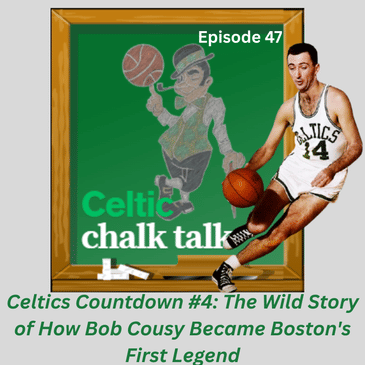
Celtics Countdown #4: Bob Cousy — Show Notes
Steve Purciello continues the Celtics Countdown series, moving to number four on his list of the greatest Boston Celtics of all time: Bob Cousy. Steve breaks down Cousy's remarkable resume, from his eight championships and 13 All-Star selections to the origin story behind his ambidextrous, no-look-pass style of play. The episode traces Cousy's path from a scrappy kid in New York City through Holy Cross, a chaotic path to the NBA involving two different teams folding, and Red Auerbach's reluctant embrace of the "local yokel" pick that became a legend. Steve also shares a personal memory of watching Cousy's retirement ceremony as a nine-year-old, an experience that helped spark his lifelong Celtics fandom.
Timestamps:
00:00 — Introduction to the Peach Basket Network and today's episode
01:00 — Setting up number four on the Celtics Countdown: Bob Cousy
02:00 — Cousy's career stats and accolades
03:00 — Early life, playing basketball left-handed after a hand injury
04:00 — High school success and heading to Holy Cross under Doggie Julian
05:00 — Considering a transfer, advice from Joe Lapchick
06:00 — Entering the NBA, the Tri-City Blackhawks and Chicago Stags saga
07:00 — The dispersal draft and Red Auerbach's reluctant pick
08:00 — Joining the Celtics, early struggles to win a title
09:00 — The Bill Russell and Tommy Heinsohn draft, first championship
10:00 — Cousy's peak years and the 28-assist game
11:00 — Retirement ceremony and personal memories
12:00 — Life after playing: Boston College and the Cincinnati Royals
13:00 — Cousy's legacy and closing thoughts
CCT Sept 7
===
Steve: [00:00:00] Welcome to another week of "Celtic Chalk Talk." My name's Steve Purciello, longtime Celtic fan, go back to the Bob Cousy days, who we'll be talking about. Can tell you stories and would talk about it at any time, diehard Celtic fan for life. Today before we begin, I just wanna talk a little bit about this network you're listening to.
This is called the Peach Bar- Peach Basket Network. This is a group of fans, not writers, not athletes, professional athletes, or any of that. We're fans, and we have opinions and thoughts about different teams and different things. We write articles, and we do podcasts. I think they're pretty good. I've listened to quite a few, and I really enjoyed them.
I really would suggest to you people that if you like this, go, A, subscribe, but B, to the network, but B, more importantly, take in a few of them. You'll enjoy it, and you'll hear different viewpoints that you may or may not agree with. So it's a good thing to try out. [00:01:00] Now, today I'm down to number four with the Celtics, and now we're getting into the Mount Rushmore type situation.
And for today, the first part of Mount Rushmore would obviously be Bob Cousy. Not obviously, but would be Bob Cousy. A couple things I wanna read about Cousy before I even begin to talk about him. He won eight championships. That's not bad. He was the MVP in 1957, 13-time All-Star, two-time NBA All-Star Game MVP, 10, and back then they played that All-Star Game very seriously, 10-time first team All-NBA, two-time second team All-NBA, eight-time assist leader on the anniversary, NBA anniversary teams in '25 year, '35 year, '50, and '75.
His number 14 is retired, which I'll talk a little bit about that later. So what you see there It's just tremendous career, and this was at the beginnings of basketball, really when basketball was just [00:02:00] starting to grow roots, but really wasn't-- The college game would be more famous. Now, Bob Cousy, as a kid, fell in love with basketball, started playing at 13.
Nowadays, if you did that, you'd never get to the NBA or wherever he achieved. What's an interesting story is he got cut his freshman year, sophomore year in high school, and in his sophomore year after, he broke his hand, wrist area right side, right hand, and that forced him, 'cause he loved basketball, to play the game left-handed, which led to his ambidextrous ways and his ability to go behind the back, his ability to throw no-look passes and do those things, because a-again, it changed his whole periphery and vision of the game.
So that was the big thing. Growing up, he grew up in New York City, French immigrant parents not too good English-speaking but, he grew up in, in that kind of of a not a wealthy fa- situation. By his junior year in high school, became all, everything [00:03:00] very good.
Senior year, did very well. Ended up going to Holy Cross. Holy Cross was coached by a guy by the name of Doggie Julian. If you look into the annals of basketball, you would find that Doggie Julian is a legendary coach. So that, that would be important. His first two years, he felt he wasn't playing enough, and this is an interesting thing to understand when you think about the NBA and college and high school basketball today, where coaches will pirate guys at anything.
So he wasn't happy after two years at Holy Cross. He wrote a letter to legendary St. John's coach Joe Lapchick saying about he was interested in transferring. Lapchick's reply was, "You're playing for a great coach. You don't wanna go through the transfer process. Hang on 'cause you'll get... he does things fairly, and it's correct."
Now think about coaches today doing that when the, when a talent wants to come to them. Anyway, he finished out his last two years at at Boston Co- at [00:04:00] Holy Cross, and he was great. Led the team into the tournaments and just was considered a great player. So now NBA time. Now, the NBA at that time was not looked upon too highly and Bob Cousy had a little driving teaching people how to drive business.
So what does he do? The Tri-City Blackhawks have chosen him in the draft. Now they're a team with three different cities. One of them is Moline and small cities in the Midwest. So he wants 10,000 a year. Now think about that, 10,000 a year in today's world. But anyway, because of the driving school, he'd have to move and he didn't wanna lose money.
But anyway, Tri-City doesn't like it. They trade him to a team called the Chicago Stags. Chicago Stags get him and unfortunately they were disbanded that same year. So now Cousy's, him and two other players are desired by the NBA [00:05:00] and not much else on that Stag team. So what does Cousy-- Cousy goes into the draft.
Now everybody in Boston is one of the teams that is in this, going to be in the draft. They will have the third pick. Red Auerbach, a great, we all know one of the greatest general managers or if not the greatest of all time, made a lot of great moves. This is sometimes you get lucky. Boston had the third pick.
So what happens? First of all, the people in Boston wanted Cousy 'cause he was a local hero. Red Auerbach was not big on that and what does he said? He said, "I'm, am I supposed to win or do I make these local yokels happy?" Anyway, Boston gets stuck with Mr. Cousy. They didn't get stuck that bad, but they got stuck with him.
Cousy ends up With the Celtics, Red's not happy. Owner Brown is not happy that they got him. But, they're gonna go on and they're gonna play. So now he [00:06:00] goes with the N- with, into the, with the Celtics, and the Celtics are an interesting team. Red Auerbach going back in his theories of coaching, and if you followed the Celtics you'd know they always got off to good starts under Red, and then they would slow down and come back to the pack.
Red believed in preseason just running these guys ragged, getting them into better shape so they got off better. But naturally it had its, as the season wore on it wore them down in some ways, but also didn't, they couldn't keep up the pace of winning. But they would always get one of the better teams and always be near the top record, if not the top record.
Cousy's first couple years, Boston would always have a great record, but they couldn't win. And there was a lot of comment or discussion about, you know is Cousy that good?" And so on, and they, need more and the like. So now we move along and it's six, seven years in and there's a, a draft coming up and Boston, the-- it's recognized that [00:07:00] Boston does need a big to go with Cousy.
So now Red Auerbach, and I will get into it in a couple weeks, but Red Auerbach, through his wisdom, is able to pull off getting Bill Russell, who is the best college player in the country and leading a team that's won a million straight games and also University of San Francisco, and also an All-American and all that.
He gets Bill Russell. An interesting side note to that is in that same draft, he got Tommy Heinsohn. So he had two All-Star, two, two great players in the same draft, Hall of Famers So what is-- what happens here? Russell comes in, first year, bang, they win the title. They win the league championship beating St.
Louis in a tough seven-game series. So that's Cousy's first title. In the next year, Boston, Russell hurts his ankle in the playoffs. Boston loses in the finals to St. Louis the St. Louis Hawks, for those people wondering. In that series, four to three, Russell tries [00:08:00] to play, but he was hobbled. But from that point on, Boston went on and continued to win, and that was the beginning of Boston's run of titles.
Cousy now is starting-- he's great. Ev-every year he's great. In fact, in, in the '58, '59 season, 28 assists in a game. Unheard of. Just an unheard of thing to do back then and he d- he was able to do it. And just continuing this great career, and now with Russell, they're winning titles and really demolishing much of the league.
By '61 and '62, he began to slow down. He still was able to make second team, I believe, All-NBA, but it was starting to slow down. '62, '63 was the last season Cousy played. Now, in '62, '63, there was a retirement ceremony in March at the end of the year. As a young guy, about nine years old, growing up when I grew up, baseball was always the big sport, [00:09:00] and basketball was just coming for me, liking baseball first.
I grew to love basketball as time went on. But anyway, one day I remember watching a ceremony, it was an afternoon game, a ceremony of Cousy retirement, which began to build my love for the Celtics. But, and it was just, I never saw anything like that. Back then, they didn't do things like that. But they, beautiful ceremony, and it was very serious, and it was very tense.
And a guy by the name of Dillon, Mr. Dillon, yelled out, and it was this quiet s- couple seconds, Bob was talking, and he yelled out, "We love you, Kooz." And that kinda just calmed it down. The people went crazy. They went, went just they enjoyed it. And for me as a fan, it kinda, wow, this is great.
This is great. They're honoring this great player. So anyway he retired. Boston won a title, and he moved on. [00:10:00] Now, the side note to that, after he left, he became the head coach of Boston College. Boston College, I think he was there for five years. They won, they got to the NCAs twice, and he was very successful.
From there, he went and coached the Cincinnati Royals. Now, this was near the end, towards the end of Oscar Robertson's career and he had another guy, Jerry Lucas. He tried to redo the team. It didn't work. He didn't really have a very successful four and a half years as a coach. But Bob Cousy, as a Celtic, is a legend is one of the great Celtics of all time, and by the way, he's still alive and still kicking and living up in the Boston area.
His wife, Missy, passed away a couple years ago, but he's still going, and just a great story and a great player at a different time in professional sports. That's it for this week. Tune in again next week for number three on our top 10 Boston [00:11:00] Celtics. Thank you, and take care.