
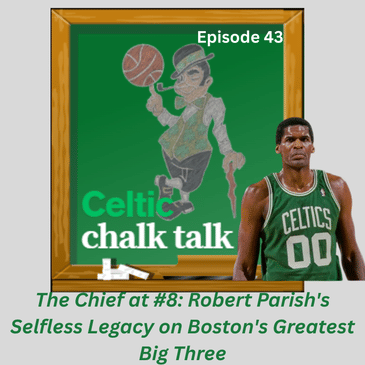
Celtic Chalk Talk: Top 10 All-Time Celtics #8—Robert Parish, plus a Don Nelson Tribute
Steve Purciello hosts Celtic Chalk Talk on the Peach Basket Network and continues his top 10 all-time Celtics countdown, reaching number eight. Before the pick, he reflects on Don Nelson’s Celtics career: acquired in 1965, a five-time champion with Boston, an unorthodox but accurate shooter whose memorable 1969 Game 7 shot versus the Lakers hit the back rim, went straight up, and dropped in, and later a Hall of Fame, innovative “mad scientist” coach who never coached the Celtics despite having his No. 19 retired. Purciello selects Robert Parish at No. 8, describing Red Auerbach’s trade that brought Parish and the pick that became Kevin McHale, forming the Bird-McHale-Parish core that won three Celtics titles. He highlights Parish’s 21-year career, Hall of Fame status, team-first role, friendship with Bill Walton, and an on-court fight with Bill Laimbeer in the 1987 playoffs.
00:00 Show Intro
00:17 Peach Basket Plug
01:21 Don Nelson Legacy
02:53 The Shot That Broke LA
05:10 Parish Joins Boston
06:13 Big Three Chemistry
07:48 Team First Mindset
08:49 Parish Skills And Role
10:24 Laimbeer Fight Memory
12:01 Wrap Up And Next Week
Celtic Chalk Talk - Aug 10 2026
===
squadcaster-9i59_1_08-10-2026_142332: [00:00:00] Welcome to another week of Celtic Chalk Talk. My name's Steve Purciello, a lifelong Celtic fan going back to the Bill Russell days and a little bit of Bob Cousy. It's been a while, and I'll always be there, a fan for the rest of whatever my life has. Now, before we get into this today, and we're doing the top 10 all-time Celtics, we're down to number eight, but before we do that, I just want to remind you that Celtic Chalk Talk is a, an independent group of people who put podcasts and write on the Peach Basket Network, peachbasket.net.
You can use that and go to that, and you can listen to the various podcasts. This is just one of the many, and there's a lot of good podcasts on the website. The people that have done them are just fans like myself. We've watched a lot of basketball, and we love basketball, and we'll talk about it [00:01:00] freely.
I really urge you to support this. Look at the website, see what you can pick out and just listen to some of the excellent podcasts and read some of the articles. You'll enjoy it. Okay, number we're down to, we're at, or not down to, number eight on the all-time list. But before I get to that, I wanna just say a couple things about Don Nelson.
Don Nelson, five titles, and I'm only talking about with the Celtics. He was an innovative coach and an outstanding coach and a Hall of Famer. But with the Celtics, I believe in '65, the Celtics picked him up after the Lakers had dumped him, and it's ironic the Lakers dumping him and the Celtics getting him.
He came to the Celtics, won five titles in 10 years. Oddly enough and I'll talk about Nelson's actual basketball ability, but what was really odd was some-- He was not an athletic person, and he yet, I believe in the [00:02:00] '75 season or '74, he was the top percentage shooter in the league. Very good open 10 to 15 foot shooter, which was big in those days.
He was not athletic at all but he did things that were amazing. The other, the things I'll remember, I'll give you two memories. If you watched him shoot a foul shot, it was almost like he shot put it with one hand, and he was very accurate. But it was really ironic to watch, and you saw that and said, "Oof, this isn't good."
But it went in, and it was successful. Red Auerbach, that genius, did pick him up, and Red Auerbach made him into a sixth man for a while, and he was outstanding. Really outstanding with the Russell days and then with Cowens and Jo White and that group and Havlicek of course. But he was just a great player and for the Celtics.
Number was retired, number 19. The other memory I have, and this was something I remember as a, a kid watching the [00:03:00] game seven against the Lakers in, what is that? '69 season which was my favorite Celtic team 'cause they weren't that good and they won it all. But they're playing the Lakers who have Jerry West, Wilt, and, Elgin Baylor.
Late in the game, Celtics were trying to hold on. They were winning by over 10, and then they're just trying to hold on. The Lakers are making a run. This was out in in LA, the game in the brand new Coliseum. And now there's about... I don't remember the exact time left, but I do remember Havlicek, shot clock's going down, Boston's in trouble, it's a tight game.
Shot clock's down, Havlicek has the ball, and he's dribbling actually away from the basket, and somebody gets in, I think it might've been Keith Erickson, flicked the ball away, and it went towards the center of the court at the foul line area. And who's standing there was Don Nelson. Now, right there, you're very lucky to keep possession, but more more importantly, the shot clock is down.
Nelson's gotta make a [00:04:00] decision. Nelson throws up a shot And what happened was something I've never seen. I've seen it in the last couple years, but I really rarely seen, like Tyrese Haliburton's shot against the Knicks in the playoffs two years ago. The ball hit the back of the rim, and I remember sitting there watching it and saying, "Oh, damn."
Ball went straight up in the air, and then it came straight down in the net. That was the shot that broke the Lakers' back, and the Celtics did hold on and win the title. Nelson, to me, was an, a consummate professional great player. Coach, we know he's a Hall of Fame coach very innovative as a coach and one of the people we have interviewed when we were working on something else had told us that who played for Nellie, s- it was Garvey Grevey, Kevin Grevey, told us that he was like the mad scientist.
He would throw any five on the court, didn't care. So he also was innovative and very, obviously very bright. The [00:05:00] irony of this was, as a Celtic and a Celtic with his number retired in '78, he never coached the Celtics, and that- that's the irony of it. But now we go to number eight, Robert Parish is who we select as number eight.
Robert Parish came to the Celtics in an odd way. Red Auerbach again found Don Nelson, but he also found Robert Parish in a crazy deal. He had the number one pick. He decided to trade that and the first pick in the draft to the Golden State Warriors because Joe Barry Carroll was presumed to be the best player in the country, player in the country.
In return, he got Robert Parish, who at that point was a young player for Golden State and really struggling. He really wasn't as good as they thought. Obviously, Auerbach saw the potential and went and got him. Now, he also, and this is the brilliance of Auerbach, while surrendering the first pick and getting the third, he wanted the player.
He-- [00:06:00] and he got Parish, but he also got that third pick, and that third pick became another pretty good player for the Celtics. Pretty good, I say facetiously, a great player for the Celtics, guy by the name of Kevin McHale. That trade with Larry Bird created that big three that just-- They were great. They were a great team.
They won a, a couple, three titles in his years. Parish was such a good player. He played 21 seasons overall in the NBA, which is a long time. Finished with the Bulls and he won a fourth championship, but really at that point he wasn't getting a lot of time. He's also in NBA on the anniversary teams in the '50s, 50 years and 75 years.
He's a member of that Hall of Famer. Ironically, Hall of Famer When Boston got Bill Walton in '85, most players like a center, Walton's a center, would be reluctant because they're figuring they're gonna lose playing [00:07:00] time. Parish immediately connected with Walton. Connected so well that when Parish got inducted into the Hall of Fame, he asked Walton to give the introductory speech.
Tells you about the Celtic culture and about the type of person that Robert Parish was. Robert Parish and Walton did become pretty real good friends. In fact, Walton dragged Parish a few times, and as well as a bunch of other Celtics, to Grateful Dead concerts, which is another story for another time.
Parish w- Parish was out of Century College, had that double zero number, which was unique back then. Now other players wear those numbers, like Jason Tatum with zero and so on. But he was unique in that way. He was an All-Star numerous seasons. He just did so many great things for the Celtic team.
The best thing I can think about without going back into memories yet was you have Larry Bird and Kevin McHale. Kevin McHale was like the black hole. He never-- When he got the ball in the post, he didn't pi- kick it out. [00:08:00] Larry Bird was just great, and Parish was willing to be the defender and the rebounder, and he did it quite well, and he could score.
But he did the roles that were needed for the Celtics. And Parish, when you've heard h- hear-- have heard him talk in the last few years, he always talks about it, Red Auerbach talking about it wasn't the number on the front of your uniform. The number on your back and the name on the back.
It was the number on the front and the team name on the front because you played for that team and that's the most important thing. He said Auerbach sold us on that, so naturally we were all team players and winning titles was the most important thing. That to me was just such, such an important thing.
His ego wasn't there. Now Parish was the-- As a player he was a recep- receptor of numerous passes, usually by Bird, and he'd get open shots. Now if you watched him play, he had a [00:09:00] funny shot. It was above his head and it always was a high arcing shot. Always arcing, but he shot real well from around five to 10 feet around the basket.
And he'd always be open because naturally if Bird cr- created some commotion, the defender drifted towards him and Parish would be the guy to get the ball and score. Parish scored when needed, didn't have that, that ego that wanted the ball at all times. He just did things. And what's very interesting, Parish, when he talks about those Celtic teams, he talks about Walton just being amazing with his, with the Celtic second team being able to play against the first team, which was Bird, McHale, and Parish, and hold their own because of Walton.
So Parish understood what the Celtics were about, which makes me really happy because as a Celtic fan, I think that's what they are about. But also Parish not just understood, he played that role. Never did [00:10:00] he complain about not having the ball. The only time he had a little bit of a problem, and him and Bird had a player team relationship, not outside.
But the only time he was upset was he felt in, I believe in '83, Bird didn't support him when he was looking looking to get more money and so Parish was a little standoffish after that, but he still considered team first. The other memory I have, which was really a, a very clear memory I remember real, real well.
Game seven, or game six rather I believe it was, they're playing the Detroit Pistons in the playoffs. Now it was '87, and this was where the Celtics were on the down. They weren't gonna beat the Pistons in this series. Was it game six or maybe Whatever, but the point being Laimbeer had done some things to Bird throughout the series and Laimbeer, Bill Laimbeer was just a player that nobody liked.
He was dirty. He was flat-out dirty. He could play a little bit, but people more remember him for his dirtiness. [00:11:00] On the pick and roll with him and Isiah Thomas was tremendous 'cause he can pick and pop all night. But anyway, Laimbeer was giving Bird a little bit of a hard time in the series, and something happened, a rebound or something and Parish just went out and hauled into him.
He threw a couple punches at Laimbeer and started a big fight. The irony of it, it wasn't like today. The referees had no video to go to or anything like that. No fouls were called to that, and the game went on. I believe Parish was suspended in the next game and, for what he did, but that was administered after the game.
Robert Parish was a great Celtic, contributed so much to those three three titles. He and one other person that did, and he didn't make my top 10, was Dennis Johnson, who contributed so much to that to two of those titles. But tho- Robert Parish does stand out as one of the greats, and again, three titles, willing to sub- submerge his ego and [00:12:00] play as a team.
Robert Parish has earned number eight on the all-time Celtic list, and by the way, all of these people are Hall of Famers. That-- it-- that's it for this week. Tune in again next week. We do number seven and so on and naturally our condolences go out to the, to, to the Nelson family another great Celtic.
Thank you. Take care.