
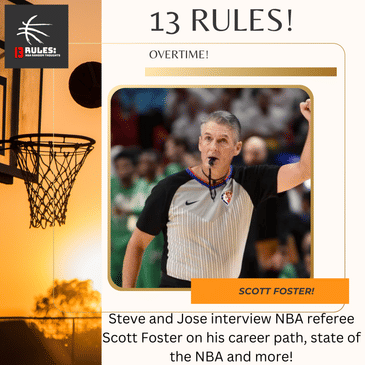
In this episode of the '13 Rules Random NBA Thoughts Overtime' podcast, hosts Jose Salviati and Steve Purciello welcome esteemed NBA referee Scott Foster. Foster shares his 30-year journey officiating in the NBA, discussing everything from his start in coaching to calling games with legends like Michael Jordan and Magic Johnson. He offers insights into the evolution of officiating, challenges faced by referees, memorable moments, and the impact of technology on the game.
00:00 Introduction of Hosts and Podcast
00:14 Discussion on Past NBA Stars
00:32 Special Episode Featuring Scott Foster
01:40 Scott Foster's Journey to Becoming an NBA Referee
03:17 Early Career and Mentorship
05:43 Rise to the NBA and Memorable Moments
07:35 Challenges and Decision-Making in Officiating
32:01 Fan Interactions and Social Media Impact
37:47 Travel and Lifestyle of an NBA Referee
58:53 Common Misconceptions and the 'Superstar Non-Call'
52:06 Training and Physical Fitness for Referees
36:41 Reflecting on Historical Moments
01:10:00 Conclusion and Outro
Powered by Beamly
Welcome to the best 15 minutes of NBA Random Thoughts online! Here, we dive into all things NBA with quick, thought-provoking insights that will keep you entertained and informed in just a short amount of time. From game recaps and player performances to trade rumors and latest news, we cover it all in this fast-paced segment.
Stay up-to-date on your favorite teams and players, and join the conversation by sharing your own random thoughts in the comments section. Whether you're a die-hard fan or just looking to stay in the loop, our 15 minutes of NBA Random Thoughts will provide you with a quick dose of basketball goodness that you won't want to miss. So grab your coffee, take a seat, and let's dive into the exciting world of the NBA!
[00:00:00] Alright, it's time to talk basketball. I'm Jose Salviati, editor at ThePeachBasket.net.
[00:00:05] I'm Steve Priscielo, longtime educator, vice principal, high school coach and athletic director.
[00:00:10] This is the 13 Rules Random NBA Thoughts Overtime podcast.
[00:00:14] During the NBA offseason, Steve and I have been discussing NBA stars from the 60s, 70s, and 80s by talking about them with someone who watched them play.
[00:00:22] Today we've discussed Will Chamberlain, Sam Jones, Rick Berry, Pistol Pete Meribitch, Jerry West, John Havlich, and, man, it's a long list,
[00:00:29] Oscar Robertson, Earl Monroe and Bill Russell. Today though we have a special show. Instead of discussing NBA
[00:00:35] greats from the past, we're discussing the state of the current NBA with one of its greatest referees,
[00:00:41] Scott Foster. Scott Foster started officiating games in the 1994-95 season, so he has been at this for 30 years.
[00:00:49] He's called games with some of the greatest players in the game, including Magic Johnson, Michael Jordan,
[00:00:54] all the way through to today's greats, Jason Tatum and tons more. Can't list them.
[00:00:59] According to the NBRA, the National Basketball Referee Association site, he has officiated 1,675 regular
[00:01:07] season games and 241 playoff games, including games seven of the 2010 NBA Finals between the
[00:01:13] Lakers and the Boston Celtics as well as some other ones where Boston came out on top,
[00:01:18] which we have to call out for fair. Quite a few.
[00:01:20] With that, I thought you and Steve and I are thrilled to welcome the 13 rules.
[00:01:24] Scott Foster, Scott, thank you so much for being here today.
[00:01:27] Thanks for the exciting beer. Good to see you guys.
[00:01:30] Pre-sure thing. Fire away.
[00:01:31] Let's go. Let's talk about when we're a site dedicated to basketball, we're a site made up
[00:01:37] of fans. You know, we're coming at this from a fan's perspective. Got a few things to ask you,
[00:01:41] but we want to start with your pat, right? To become an NBA referee. How do you do it?
[00:01:45] How do people do it if this is something they want to do? And along the same lines,
[00:01:50] what do you remember about the first time you had that whistle and took an NBA court for a game?
[00:01:57] Oh, there's a lot more before I got to the NBA court. I got lucky. I was coaching my little
[00:02:01] brothers in basketball and a guy said to me after their game, hey, if you stay, we'll give
[00:02:07] you five bucks to referee the next game. And I was like, that sounds good. So I rested,
[00:02:10] stayed and referee. And then about a month later, I took my brother's team to a tournament
[00:02:15] and the guys said, part of this deal is you have to stay and referee a game. We'll give you 10 bucks
[00:02:19] towards your entry fee. And so I stayed and I remember a guy going baseline and I had no idea
[00:02:24] what I was doing, but I saw a foul and I blew my whistle and I actually put my fist up and I went
[00:02:28] to the table and I reported it and I gave me this great satisfaction. So I said, I think
[00:02:32] I like this referee thing. So I stopped coaching. I picked up coaching my daughter's AU team
[00:02:36] some years later, but I stopped coaching and I started ref frames from Montgomery County Rec
[00:02:41] Department for $3.90. That was minimum wage in 19 probably 86. And I was taking courses at Montgomery
[00:02:47] Junior College for one year before I went to Maryland. And my accounting teacher, Bill Johnston,
[00:02:52] walked by my desk after one of my tests and I happened to have the Federation rulebook out.
[00:02:56] And he looked at me and said, what are you doing? And I thought he was admonishing me for
[00:02:59] not doing my accounting when I was done the test. So I'm sorry. I'm ready to
[00:03:03] high school rulebook. I'm referee and bitty bites down at the rec center.
[00:03:06] $3.90. And he says, no, that's a stupid idea. You need to go over here. Let me make a phone call.
[00:03:11] So it turns out he was a high school referee. He made a phone call, got me into the class,
[00:03:15] which was in his third week of six. And I took the class for three more weeks. I just passed
[00:03:19] the test by the skin on my teeth and I became a IBO certified referee in 1986. And so back
[00:03:26] then no cell phones, none of that silliness. And so I'd come home from college and my
[00:03:31] grandmother would have a list of games for me to go referee, not going to DC or Rockville or
[00:03:35] Montgomery County. I'd work like three o'clock at the middle school and five o'clock to JV. And
[00:03:39] then I'd go to the men's rec league at six and then at nine o'clock I'd go to the same
[00:03:43] no to drugs league. So this went on all through my college days. And the nice thing about the
[00:03:47] one of the University of Maryland was as I got started, I was close to places like the
[00:03:52] Massa and Gonzaga and because I could go in the back door from University of
[00:03:56] Washington DC. So I was working Dunbar, Cardozen, some really high level basketball in the DC
[00:04:02] area. That's helped me get going and I had some nice mentors along the way who helped me out.
[00:04:07] And a friend of mine said, Hey, you got to go to this referee school. So I went to the ACC
[00:04:10] referee school run by Fred Bearcat, did okay my first year, came back the second year and was
[00:04:16] ranked one of the top three guys in that camp. And there was a couple NBA referees who had
[00:04:21] just been added to the roster of the NBA when they went from two man to three man.
[00:04:24] And they gave my name to the NBA. And the next summer the NBA came to look at me
[00:04:29] at James Madison and they took me to the LA per summer. And so when I went to the LA
[00:04:34] per summer league, I really in my mind wanted to be an ACC referee and I thought this would
[00:04:39] help me get there. I had no thoughts of being an NBA referee, even though George
[00:04:44] Talber said, I think you're a naturally being an NBA referee. I was like, that's insane.
[00:04:47] And so I was out on the court hoping to do Duke, North Carolina and ran down the court. My
[00:04:52] first game and they were playing it was Boston versus Seattle. And I don't remember which one
[00:04:58] of you is the Boston came, but just saying a Boston Wall State game. And Rick Fox was a rookie.
[00:05:03] Gary Payton, I believe was a rookie Sean Kemp was in his second year. And so Gary Payton
[00:05:09] grind down the left when he throws an alley past it's way too hot, way too hot. And I just
[00:05:14] quit on the plane. I'm like, what's he doing? And all of a sudden Sean Kemp comes out of
[00:05:17] nowhere. And I'm looking through the rim and he unleashes the most ferocious dunk I've seen in my
[00:05:24] 31 years or actually, so that would be 31 plus four. So 35 years of pro basketball. Best dunk I saw
[00:05:31] in 35 years. And I think about that. And I just my mouth went, Oh my God, like this is unbelievable.
[00:05:38] And I remember thinking screw the ACC. I want to be an NBA referee. And so from that moment
[00:05:44] on, it was all very targeted. It's what I wanted to do and where I wanted to go. And I remember
[00:05:49] during that game that Boston coach took over his name. He there was center's name was Igor. He was
[00:05:53] from somewhere in Europe and I called a foul on him. It was probably terrible. And he says,
[00:05:57] don't worry Igor, that guy's never going to make the NBA. And I've been waiting now 31 years
[00:06:02] to see that guy. So I'm telling you, I'm sure he knows that I made it. But but I would
[00:06:06] love to see him go, huh, didn't they got Megan on? Anyway, that was how the deal went
[00:06:10] for me from beginning to end to the NBA. I did two years in the CBA, which was exponential learning,
[00:06:16] two man officiating to I should say two young men officiating, because most of the 20 year olds,
[00:06:21] we were out there learning on the job, teaching one another surviving. And that league was just
[00:06:26] a really cool, you could do a whole podcast on the CBA, just a really cool experience for I
[00:06:31] think players, mascots, cheerleaders, you name it, we're all trying to get the NBA,
[00:06:35] we're all cheering for one another coaches flip Saunders was there when I was there and
[00:06:39] Eric Mulsman and people like that. So we had two years in the CBA, which I could tell stories on
[00:06:43] that all night. Yeah. Have you had a chance to enact with the Rayman, Sean Camp and tell him his
[00:06:49] part in your origin story? Because that's pretty cool. I've seen Gary a bunch of times. I've seen
[00:06:54] Gary Payton tons of times I've told him that story. In fact, since last year at Levy
[00:06:57] played 17 years in the NBA, he bought me a drink. It was after the season was over,
[00:07:02] I saw him at a bar and and I said, maybe I should buy you the drinks and I call
[00:07:05] all his money and fines and technical vows and that sort of thing. And he couldn't have been more
[00:07:09] gracious. He was totally different guy than the trash talking Gary Payton that I met.
[00:07:13] The most in stories I have about players are that where I find that I love these stories are
[00:07:18] off the floor, right? So I've seen Gary Payton at a bar and he buys me a drink while
[00:07:22] he's playing pool. And I told him that story and we had a good laugh about some other stuff
[00:07:26] that happened during our careers. But yeah, so I haven't seen Sean ever at a game. But I
[00:07:30] see Gary because obviously his son plays in the league and he's still connected in some
[00:07:33] ways with the leagues, but not Sean. Scott, the first NBA game you worked November 9th, 1994,
[00:07:39] I believe was the day a young and surprised second year Shaquille and Neil played a team at
[00:07:45] Charlotte's and they have two guys by the name of Larry Johnson and Alonzo Morning on the team.
[00:07:50] And what I remember about that game is it went to double or triple every time and I
[00:07:54] called a play on Nick Anderson that was not very good. Didn't cost anybody the game just
[00:07:58] wasn't a very good call. And Nick Anderson still likes to remind me of that 31 years later
[00:08:03] when I see him in Orlando. But I remember Shaquille, Larry and Alonzo were trying to fowl
[00:08:09] Shaquille as he went into his upper shooting motion and they were so he had 290 pound a man
[00:08:14] on this side. He had 290 pound a man on this side and he just took them both up to the
[00:08:18] dump rim and just dunked it. And I remember thinking everybody talked about how big Shaquille
[00:08:22] was but his agility, his speed, his strength, that was impressed me because there's lots
[00:08:28] of guys. So we see guys who aren't in the NBA walking out of the street or 740 but this guy
[00:08:31] was just an amazing specimen of a human being to be able to pull up in my first game and do that was
[00:08:38] like really amazing feat. So yeah, that was my first game. And my second game was actually
[00:08:44] with Ed Rush in San Antonio that Nick's played and I learned a valuable lesson that day.
[00:08:49] It was after that game we were talking about did my dad watch who was it? No, it was again
[00:08:54] my third game with Ed and he said, your dad watched the game. I said, nah, he just watches
[00:08:58] the big games. I didn't mean it like I've mentioned as in my dad thinks it's a big game. Every game
[00:09:03] was a big game to me and still it's how I prepare for every game but Ed Rush really
[00:09:08] drilled a home with me for the rest of my career that you have to take every game whether
[00:09:12] it's October 3rd or June 3rd or the same and prepare the way you want to perform on a
[00:09:17] consistent basis. So I actually remember my second game and things I learned more
[00:09:21] with from Ed Rush than what I first game was. That's so interesting and something I hadn't
[00:09:26] had planned to ask but I think it's important, right? How do you get up for a Tuesday night game
[00:09:32] in Charlotte, right? Against a bad Grizzlies team. Let's just say how do you add? If you ask Michael
[00:09:38] Jordan the same question he's going to go out and try and score 40 on them. If you ask
[00:09:41] any person who wants to be a lead at what they do, I don't care if you're our teacher or
[00:09:45] whatever you have to prepare every single day and get up for your day and go out to work.
[00:09:48] And so for me, there's the fear of failure and there's plenty of fear of Twitter and
[00:09:53] everything that really kills that comes with my job even on a good night. So if I take a night off
[00:09:58] where I don't get up for that game, I'm letting the game down for the that's the biggest thing
[00:10:02] you don't want to let the game down. I'm letting down my partners. I'm letting down the NBA.
[00:10:06] I have to focus every night and prepare tonight. And really if you do that it makes
[00:10:10] it so when you get to June 3rd and you have 300 million people all over the world watching you
[00:10:14] working for the NBA finals or game seven in the NBA finals, it takes some of that nervousness away
[00:10:20] because you've prepared every single night. Whereas if you take it now I'm going to work hard tonight
[00:10:25] not tomorrow. You're not going to have a successful career. I don't care what career you have with
[00:10:28] your NBA referee or a teacher or whatever. So yeah, being consistent in your preparation
[00:10:32] every night is big and I've never had a problem getting up for a game. I have routines I go
[00:10:37] through every night and when the ball goes up, I'm excited to be there every single
[00:10:40] night. Yeah, super cool. What we're talking about. Oh, good Steve. I just wanted to
[00:10:45] follow along the toughest call you have to make in a game. Yeah, if everybody will say
[00:10:50] block charge or something like that. For referees it's out of bounds for me anyway.
[00:10:55] You had the ball bouncing around and could hit one or three feet or a hundred different
[00:10:59] finger tip with fingers and goes out of bounds with lightning pace away from on a closed
[00:11:03] angle or to shoot down and you look for help. And so for me slowing down and getting out of
[00:11:08] bounds plays is really the toughest play. Block charge for me isn't difficult because we're
[00:11:14] trained to pick up the defenders, see their legality and then there's a collision. So you
[00:11:18] can figure out whether it was illegal or not legal. No matter how fast that is as long as
[00:11:22] your eyes are moving to where they're supposed to be, you're ahead of it. So it'd be like
[00:11:26] being a hitter and this is a lot. Being a hitter sometimes I give this analogy
[00:11:30] for fishing when I'm really on my game a 90 mile per hour fastball looks like a 75
[00:11:35] mile watermelon. And when I'm struggling a little bit, a 70 mile per hour fastball looks like a
[00:11:41] little peak. Having quick eyes and it's interesting to me that we have younger officials that figured
[00:11:46] out that you should train your eyes just like you do your biceps and training our eyes to be
[00:11:50] quick. And so I have an app in the game by no locker room part of my routine that I go through
[00:11:54] and you're searching for things you're playing a game and that's a video game but
[00:11:57] you're playing this game and it keeps your eyes moving rapidly quick. So when you're as
[00:12:02] you get older, it hopefully helps you zoom in, zoom out as people like we talked about with Sean Kemp
[00:12:07] coming to the rim at 400 miles per hour. And now all of a sudden someone comes out of nowhere and
[00:12:10] be able to see that contact. Yeah. So there's lots of things like that but out of bounds is
[00:12:14] the toughest call for me. Good. We talked a lot about your first year, your first couple of
[00:12:20] games back then nobody knew who you were right today. You take the court people know who
[00:12:24] you are. Scott how is that changed maybe your preparation? Who's
[00:12:30] who has got fostered in and who's got fostered now? What's changed in 30 years? My hair color's
[00:12:35] changed. I went from black to gray so that's the biggest thing that's changed how fast I run
[00:12:39] is changed but people might think oh Scott likes that part. The last thing in the world I want
[00:12:44] to do is be seen or be heard from or have to talk to a forward reporter after the game about
[00:12:48] what just happened in the game or be talked about on Twitter which is just part of the job
[00:12:53] now when I got in the NBA social media was a part of the job and unfortunately for me it is
[00:12:57] now. I would say the my first year in the leagues, my first couple years right out of the gate I had
[00:13:04] a situation my second year my first nationally televised game on NBC that was the way your career
[00:13:09] works in the NBA is you are an umpire that means you're the lowest person on the crew
[00:13:13] and then you become and then you hope to get some games that are high-profile and you're
[00:13:18] being rewarded in some way back then anyway maybe not so much now but back then it was like
[00:13:22] if I could work in NBC that's really showing that they trust me this was back in 1995
[00:13:25] Bob and so I was given a game on NBC was Phoenix and the Lakers and during the week
[00:13:32] Dennis Rodman had butted Teddy Bernhard and Nick Van Exel had bumped into Ronnie Garrison and then
[00:13:38] a lot of people came out and were like hey we just can't happen and then and not just with state
[00:13:43] but we had a game and no call and magic and I bumped into one another and I had ejected him
[00:13:48] from a game and then all of a sudden that's the first time the spotlight came on. I remember
[00:13:52] half time going to the locker room and Bob Costas is talking about it on tv and it was like Kennedy
[00:13:56] just got shot again where the space shovel just blew up and it was like this big thing and the only
[00:14:02] thing that kept me from this the cover sports illustrated is Greg Norman Blow and the uh
[00:14:06] six-shot lead to Nick Fowler. Anyway magic was so gracious sent me a nice letter afterwards that
[00:14:11] after the incident that's where the thing the class act that he is and and we moved on from
[00:14:16] there at whatever I remember the next night going to Denver and and Greg Grant had a problem
[00:14:21] with the play and it was play all kind of game whoever won was one of the playoffs I believe
[00:14:24] because it was like the last two of the season and when he went to ask me a question he was like
[00:14:29] hey Scott and I went yeah and he was I never mind and I went huh and he is you'll throw magic I
[00:14:34] know you'll throw me way out of here and I was like wait that's all that's not true but
[00:14:40] that's the first spotlight I had and then throughout the next 29 years it just
[00:14:45] became we grow and you get the bigger games that are on national tv over and over again or
[00:14:50] you're getting the files games for 20 years for your social media beating up over an article
[00:14:54] that was written about you that's gonna that's gonna happen the way you deal with it is you
[00:14:58] just go out and do the work and hopefully the work speaks for itself yeah but I'm in LA
[00:15:04] Steve's in Boston a Boston fan not in Boston but I remember that was magic had just come back
[00:15:09] right and so yeah it was a lot of excitement and so it was unique and I understand the
[00:15:14] blow-up but what I didn't understand until just now and what I think is unfair is
[00:15:19] you connect with these guys off the court you reconcile you work it out you and magic you and
[00:15:25] Gary Payton we don't know about that right so all everybody here's about is what they see and
[00:15:29] it's unfortunate but it's good to hear that let's say 90 percent of the time 75 percent of the
[00:15:34] time you're good with these guys off the court. People don't understand this what happens that
[00:15:38] in during the game is part of competition when I was a competitor I wasn't always the nicest
[00:15:42] guy in the world I'd be the first one to tell you that and when I talked to people
[00:15:46] like Gary Payton especially where you just realized that he was competing he was out there competing
[00:15:50] that you're not going to get the guy at Sunday school well he's competing and now there are some
[00:15:55] guys who can do that where they're just these gracious sides they can be all the time whether
[00:15:59] they're competing or not and that's awesome but when the games are over we can go to the bar
[00:16:04] and have a beer one of the best guys that used to always talk about this was Jerry Sloan
[00:16:09] like he would he'd scream and yell and I remember he and I got into and I actually
[00:16:13] apologized for something I said to him and he goes hey kid don't you worry
[00:16:16] well that ball goes up I'm going to get on you you get on me and I'll meet you at the
[00:16:19] Hilton for a beer afterwards and sure enough we went to the Hilton afterwards he was sitting
[00:16:21] right there and a beer came my way he was a man of his word that's how it should be right
[00:16:26] and and I think that most of the time not all the time but most of the time that that's what
[00:16:30] we move. I couldn't have known as a fan I think I appreciate that. Well one thing you have
[00:16:34] to remember is we understand that there are juices and we see the people on the court
[00:16:38] but we have to be we have to move on because we get graded on every single call every single
[00:16:43] decision and I'm not going to mess up another play that's going to make you mad because I want to
[00:16:48] get an A plus in my test every single night. I don't only get 99 out of 100 I want to try and get
[00:16:53] 100 out of 100. Have I ever done it? Oh I'm a big 0 for 1750 regular season games and an 0 for
[00:16:59] 300 playoff games and that's a lot of 0 first. I've never had a perfect game in my career so
[00:17:04] that'd be the first 100. Did you ever lose your cool during a game? Sure yeah you have to
[00:17:10] if it comes with your experience and your training where you have to make decisions
[00:17:14] out of what's happened rather than emotion and but you're always going to have a moment in your
[00:17:18] life and I'll care what you do for living where your emotions make you make a good decision
[00:17:23] or bad decision but yeah I mean I'd be lying if I didn't tell you that I've lost my emotions
[00:17:28] from time to time but I think that the manager team the NBA through the years has
[00:17:33] helped every referee with that and so that's why sometimes we get labeled as robotic or something
[00:17:38] like that or not unnatural or on that you know all these different words they use to describe us
[00:17:43] it's all because we're being trained on how to deal with people and so we come off as professional
[00:17:48] we can and then there's just nights where that's just not going to happen. You had mentioned
[00:17:53] getting graded and having an 0 for in your season which yeah I appreciate that honesty
[00:17:59] how does that work do you get graded immediately does it come via email is it weekly how does that
[00:18:04] work so it works a lot of different ways first of all every NBA referee is their own worst
[00:18:09] critic and if they're not it wouldn't be NBA referees and so when we get to locker room
[00:18:13] I've had people throw stuff in the locker room where they're like I can't believe I missed
[00:18:17] that car they're upset with themselves that sort of thing so when you when we do actually miss
[00:18:21] a play it's about 0.34 seconds after we make that mistake that we realize it before you see
[00:18:27] the replay and you realize it so we're in worst critics that's the first great but we do get great
[00:18:32] we have a review team that goes through each tape bounce by bounce the next day they form a report
[00:18:37] based on correct calls incorrect no calls correct no calls and they have all these different stats
[00:18:44] like they can call me in March and say we've noticed that you missed X amount of no travels
[00:18:49] which is above the league average we really need to work on pivot whatever or they could
[00:18:54] they can see trends in in my missing D3s whatever it might be so they have all this
[00:19:00] statistical analysis from from their data driven their reviews and so that helps them rank us as
[00:19:05] play callers for 1 to 74 that helps them to identify where we have weaknesses and they can
[00:19:11] help us and it also helps them with the weaknesses of our staff which then helps them say okay we
[00:19:16] need to really work on points of education or traveling or legal screens or whatever freedom
[00:19:21] whatever it is and so that data has been invaluable to the NBA in helping train us to you know be
[00:19:28] better than our jobs but yeah we're great like that we're also great at buying we have development
[00:19:34] advisors we have and then we have the head of vast operations head of raptory operations they all
[00:19:38] have a weigh-in on our rankings they put all that into a computer boom it spits out our
[00:19:43] composite ranking and we go from there I would say my development advisor being in my 31st year
[00:19:49] send me probably less plays than a first year referee but I get as many texts and emails saying
[00:19:54] hey you take a look at this what did you think about this hey can you help us with our report
[00:19:59] here so on and so forth and then after every game I follow game report with the NBA stating
[00:20:05] pretty much any pertinent mistake that the crew made during the game it may have changed
[00:20:10] how this team sucked or how the game proceeded to send that to the NBA and then it helps them
[00:20:15] again their evaluation the crew performance and their L2M yeah wow amazing I told you before
[00:20:22] we started talking I'm in tech that's my day job yeah we talked a lot about social media
[00:20:27] let's call it the bad side attack as it relates to the game I agree you're talking about
[00:20:34] the good side attack which is amazing to me the replay rule as a fan kind of changed things
[00:20:38] but I know that there's more technology in the horizon again we talked about this before
[00:20:42] we started the show so what are your thoughts on technology improving the game changing the game
[00:20:47] making your calls easier you had mentioned one particular technology that's coming soon if you
[00:20:51] could talk more about that yeah it's actually here so we have the Hawkeye system which is in
[00:20:55] the replay center it was used last year for goal tending and then with balls on downward
[00:21:00] flight and then ball in the cylinder and it's I think of the future of it's going to be
[00:21:03] whether which fingertip at last minute off of the hundred fingertips we're dealing with
[00:21:07] so they'll have that and then I'm sure there's some other uses for the Hawkeye but in the future
[00:21:11] I think we'll have referee wearing earpieces the ball go out of bounds and it'll be off
[00:21:15] number 41's left index finger and the replay center will say into the microphone it's white ball
[00:21:22] boom white ball and obviously if we don't go that direction I think the replay center will
[00:21:27] tell us quicker that it's white ball without us going over to the to the monitor and putting
[00:21:31] on the headsets and you know that's where they if it's challenged or maybe it's you know for
[00:21:36] whatever reason how would we get there that's here we've had you know we used to have replay in
[00:21:40] the last two minutes where I triggered replay where if I thought oh this is a really tough
[00:21:44] out of bounds ball I'm going to go take a look at it and what happened was you'd be in
[00:21:48] playoff games that really matter all the games matter but now you're in game six or
[00:21:52] your game seven yeah and you're in the last two minutes crunch time and you have to get
[00:21:56] these plays right so you feel the need to be confirmed on treat so many out of bounds plays
[00:22:01] so you're going over there and you could have been there finding out your right or your wrong
[00:22:04] and and slowing the game down the fans are ready to throw stuff on the floor that sort of thing
[00:22:08] so the NBA was smart they gave the coaches a challenge and now the coaches have to figure
[00:22:12] out do I hold the challenge for that out of bounds playing the last two minutes or the last
[00:22:16] that found the last two minutes and it's helped us move the game along and meanwhile
[00:22:20] come to find out in my video study that all those times we went over to look at the
[00:22:26] out of bounds the last two minutes to confirm ourselves we probably didn't need to do that
[00:22:29] because I can't think of one play this past season knock on wood that where I went oh my goodness we
[00:22:35] really kicked that out of bounds play and again like I said it's one of the harder plays in the game
[00:22:39] to to officiate so because it's so quick so something you're pro technology you're good
[00:22:45] I'm all about I'm fine with it they're kicking out of the papers and now with
[00:22:49] Twitter I'm all about it now I think it helps us do our jobs more efficiently or more effectively
[00:22:54] I remember back in the day with before replay watching knock down drag out fights between umpires
[00:23:00] and baseball and coaches face to face nose and nose bob yeah and you still see that from time to time
[00:23:05] but not as often because now it's just challenge oh he was sage challenge he was out you see people
[00:23:10] pretty much get thrown out now for arguing balls and strikes but you don't see anybody get
[00:23:14] thrown out for arguing whether you're safe or out at home or or on a tag play a second
[00:23:18] or you just see balls and strikes now which you know could be because they're being misled by the box
[00:23:24] that we all see on TV that isn't really the strike so again bad information to the public and I think
[00:23:30] sometimes in social media goes goofy it's really because they got bad information somewhere and
[00:23:35] that's a good illustration of it but I am pro technology I'm pro replay I didn't like replaying
[00:23:41] my first came in because I really looked at my first four years in the NBA before we had
[00:23:47] replay I looked at that as an opportunity to step up as an opportunity to step over it to a
[00:23:54] 30 year veteran and say no that shot was late we have to wipe that I know you swear but we got to
[00:23:59] wipe it and for a second you're at free to be able to go up to an ed rush or a joey craw for
[00:24:03] someone of those veterans back in the day and say you got it wrong I think it's late and then
[00:24:08] get it right was a great opportunity with replay now I can still do that but nobody if there's
[00:24:14] not this there's a safety net to make sure that we get it right so you know when I first got a league
[00:24:20] there was by word 70 games in the season there's 280 last second shots and I would take that
[00:24:26] an opportunity 280 times to say is it good or is it late oh it's late and then if somebody scored
[00:24:31] I was able to go into a finals referee in my second year and say hey they shouldn't win
[00:24:37] they should win because the shots late and that happens several times in my first four years
[00:24:42] and I think it led to my um assent to crew chief and then to the playoffs and to the ultimate
[00:24:47] seeded fonts so that's gone for young referees now I think that was a great opportunity when I was
[00:24:52] first there but that's okay this is better because we get the plays right more often
[00:24:57] because of yeah and you don't have a situation which replay we had a game and this was actually
[00:25:03] interesting we had a game five and I think it was Jersey Indiana and the there was a game
[00:25:10] winning shy believed by Reggie and it sent the game to overtone it was late but they scored it
[00:25:16] but what happened was so we got replayed next year so when we were being trained on replay the next
[00:25:21] year nobody ever told us whether we got to play right in the Indiana jersey game but when we were
[00:25:26] in the studio with doing the thing with the replay we realized that the clock that you see
[00:25:31] on tv has one tent more than the actual clock so if you're watching at home and you see the
[00:25:38] ball come out of Reggie's hand it says point one on the superimposed clock but if you're in the arena
[00:25:42] it said zero and so really on wood was shooting a basketball we were showing the technology
[00:25:48] and all of a sudden we all went oh my god now one tenth of a second doesn't sound like a lot but
[00:25:52] guess what in basketball that's 27 frames and is it nine it's a number of frames of film
[00:26:00] you being a tech guy could tell me but we were like maybe they did get it right in New Jersey
[00:26:04] or actually it actually meant that you got it wrong in New Jersey but New Jersey ended up
[00:26:08] winning the series and moving on I believe they went to the finals that year but that call almost
[00:26:12] changed history and so that was and then unfortunately I was a part of a rule we all you don't want to
[00:26:18] be a part of a rule change I called what I thought was goal-tending in the game in Portland
[00:26:22] which sent the game to overtime and it was like thought everybody thought we got it right in
[00:26:26] fact the announcer told me I got it right and I get back to locker room and I got it wrong
[00:26:29] and the next year they put in goal 10 replet and then one of my bosses had a restrictory block where
[00:26:35] we couldn't rule on this thing we'd replay with the inability to get it right when that should never
[00:26:40] happen and they were like you know what that's wrong we shouldn't do that and they changed that
[00:26:43] replay so anytime you could help me get these plays you not look like a fool while I'm sitting
[00:26:47] or looking at it on replay I'm all about it nice yeah it sounds oh Steve go ahead no no I
[00:26:54] wanted to switch gears unless you have something else gets related so yeah let me finish with
[00:26:58] this because I'm getting the sense Scott you're not the and I understand it right as a numpire is a
[00:27:03] referee you don't you don't want the attention on you you want it on the game right there and I get
[00:27:07] I certainly understand that but there's a point right when you have the replay where you've got
[00:27:12] to go in those national and Calvary games and you've got to get on camera in front of us bands
[00:27:17] right and you have to explain it right Billy Kennedy is great at that right he's I think
[00:27:22] he enjoyed it I think he's I think the word you look for is prismatic 100% do you dislike
[00:27:27] doing that no it's not that I don't dislike it I don't have really a preference either way but I
[00:27:33] would say is that anytime I can be the voice of what's going on rather than an announcer who probably
[00:27:38] doesn't know as much as I do about officiating the NBA which is all of them and I respect them all
[00:27:44] but I got my guys I like to pull around with Jeff and Gunn the end to say I'm glad I get to talk
[00:27:49] now but you know and you don't get into all the talking now I get to say something but even
[00:27:52] after I give him the answer he'll say no Scott's wrong like I just looked at the replays
[00:27:56] but anyway yeah so I like it because I think when we can have the ability to voice what we saw why we
[00:28:03] have to do what we're doing it helps everybody understand why we're doing what we're doing rather
[00:28:07] than you know whatever we've had plays there was an interesting play in Utah a couple years ago where
[00:28:12] the ball it didn't appear to ever go out of bounds and the guy who did the broadcast
[00:28:18] didn't explain why they were giving the ball back to whatever whoever was whether it be Utah
[00:28:22] visiting team and if you go and we're all even me I was watching him like what are they doing how are
[00:28:27] they getting out the back but no one saw it hit the referee's shoe who was sitting out of bounds
[00:28:32] who's standing out of bounds which means the ball is out of bounds and so we didn't do a good
[00:28:35] job of explaining that and it caused this storm on Twitter and everywhere else and we
[00:28:40] had to play recruited anyway and but we didn't explain it correctly and I think that's a great
[00:28:45] illustration of why this is such a good thing I think that we're going to continue to get
[00:28:49] better at the NFL officials I think are fantastic at it they've trained at it and now we're being
[00:28:54] trained much better and I think some people are more comfortable than doing it than others but
[00:28:58] but I think overall it's a good thing to have us tell you as much as we can
[00:29:03] to help educate the public yeah get back one thing you thought of something we talked
[00:29:07] about earlier and I think would uh lachaneer you talk about officials always talk about
[00:29:12] sleepless nights and being their own self replay think about Jim Joyce I think about Jim
[00:29:17] Joyce all the time here's a guy who has successful career and and there's other officials in
[00:29:21] in every sport that have this bill Buckner moment and and I think that wouldn't Jim Joyce love to
[00:29:28] have had replay that night for that challenge you come in now we have this historical game
[00:29:32] that is historical and I know for a fact he would love to have that back and I was I saw
[00:29:39] there's a special come out whether it be ESPN or whatever and I was like I just that is my
[00:29:43] worst nightmare I'm living this life this historical life and you're in these games of history and now
[00:29:50] you're on the wrong side of history and all you want to do is get it right all you want to do is get
[00:29:54] right so yeah and for those unaware Jim Joyce baseball on par who famously infamously maybe
[00:30:02] got a wrong call costing a player Armando Galaraga perfect game something that only
[00:30:06] 20 some odd players have done in the history of baseball so yeah that's rough and I appreciate
[00:30:12] Jim Joyce admitting it I appreciate him and Armando Galaraga being pals about it they're friendly
[00:30:17] which is pretty amazing in my book he's got that perfect perfect game Steve go ahead no I just
[00:30:23] switch gears a little bit Scott the first of all what's the worst situation I always like to look
[00:30:29] at the negative side of things what's the worst situation my whole life was in the negative
[00:30:34] like this summertime shouldn't we live on the positive side of things that's my whole life
[00:30:38] worst situation you ever got in in a game or whatever well I think the goal 10 play that ranks
[00:30:45] when you get back to the locker room you thought you got a right because four announcers are telling
[00:30:48] you you got a right good call we're going to overtime and then you get back and find out
[00:30:51] you got it wrong and then the other team loses and then they go on an eight game losing streak
[00:30:55] then the coach gets fired the game after I come back to me Paul and I missed in that game
[00:30:59] and he's a great guy and he's a hard-nosed you know worker and you feel like you cost
[00:31:03] the guy's job my decisions impact other people's livelihoods and so that's again another reason why
[00:31:08] it's easy to get up every single night because I don't want to be I don't want to call Steve a
[00:31:12] coaching gig that there's only 29 of them or 30 of them in the NBA and you don't want to you've
[00:31:18] you got people's livelihoods in your hands you got to be good anyway but that's the worst
[00:31:22] case scenario where you've had a gamer call that you got wrong the best feeling is when
[00:31:27] you get it right when you the right team when you go oh my god and you know I've been in the NBA
[00:31:32] for 31 years I can count on maybe two hands maybe one where you come in at the buzzer and go I got
[00:31:38] it wait that's about put two tenths back on nope sorry you're not going to win you're gonna win
[00:31:42] and it was the right call it was the right call that's how you make your living and you make
[00:31:46] your bones in the NBA where people are they trust you to have the courage to make those calls
[00:31:52] and whether you're on the road or your home and you're gonna be in the press or whatever
[00:31:55] you got to make the right decision so that's the best feeling when you get it right the worst is
[00:31:59] is when you get it wrong what about fans how about that any stories about that fans are fans I try to
[00:32:08] I try to keep it between 94 and 50 unfortunately every time I go to talk to a fan when I turn around
[00:32:13] there's 23 cell phones on me and if I say something even a little out of character they can take it
[00:32:18] out of context to get so you really have to be careful with just so nowadays I don't speak
[00:32:22] to fans very often I'll smile with them or maybe chuck with them I had a guy this year who I told
[00:32:27] hey you gotta be more original come on I've heard all this stuff come on be more rich come on get it
[00:32:31] to me bring it because I can take it and he got a big kick out and he kept trying every quarter
[00:32:35] during timeouts and he never came with anything original and really most stuff that fans say if
[00:32:40] they say something original I get a kick out of it I laugh it's fun I don't take myself as serious
[00:32:44] since people probably think but and I get a good kick out when someone gives me a good
[00:32:48] stinger I'm not all about it it's good stuff but the only fan story I'll tell you is I did throw
[00:32:54] out magic Johnson Jack Nicholson came out on the floor and he gave me the choke sign and I remember
[00:33:00] literally was at mid court and like in the center of the court and I was like Jack Nicholson's
[00:33:04] down the court I got people throwing ketchup bottles at me all kinds of stuff and so when we
[00:33:08] came back from half time I was standing there with no one fine god rest his soul and I said
[00:33:11] you know what I should have done I should have thrown that so-and-so Jack Nicholson out for
[00:33:14] coming out of the court just as I said that nasty word and Jack Nicholson in the same sentence
[00:33:19] I get a tap on my shoulder and it's Jack Nicholson and he's out he came out
[00:33:23] made court and he's apologizing for coming out he says I didn't know magic puppy Scott I'm sorry
[00:33:28] can't do you that I'm sorry I had the sunglasses on him the whole LA thing going on and and then
[00:33:32] from there on I would see Jack and he would say hello and I would tease my partner says
[00:33:36] all in my second or third year and third year veteran Jack would come go hey Scott how are
[00:33:41] you Scott oh and I'd be with a say Hugh Hollander something like that who'd been around for 25 years
[00:33:45] and he would just keep walking I'd look at I go Hugh hey Hugh Jack knows my name how about that
[00:33:50] noon so just have a little fun with it but I went and saw a movie a couple years later
[00:33:55] I see it's many years later and it was about Schmidt and so that was the movie that
[00:33:59] Jack Nicholson got a lot of press on he got a lot of awards on and I didn't particularly
[00:34:03] enjoy the movie and so we had a game in LA with 50 seconds left I believe
[00:34:08] Kobe went baseline on a hook move and I was trying to spin towards baseline he hooked Elton
[00:34:13] Campbell and I called an offensive foul that basically sealed the Lakers fate and Charlotte
[00:34:17] I believe at the time was maybe one of the bottom three teams in the league on the road
[00:34:21] and I looked up and Jack was giving me that same joke sign and he sat down that end of the
[00:34:27] way from the home bench and he came down he's giving me a good piece of his mind and
[00:34:33] he kept saying that's the worst call I've seen in 34 years in these seats Scott
[00:34:36] that's the worst call and I'm not one of those guys who's quick-witted that where I can come up
[00:34:41] with something I always think about 20 minutes later or two days I should have said this right
[00:34:44] but this one I was waiting on him I was waiting on him and I looked Jack and so that makes
[00:34:48] us even Jack because the voucher miss the worst effin movie I've ever seen and Lou Adler
[00:34:52] who is sitting there I guess he's a big time with Sony or somebody he literally fell out
[00:34:57] of the seat laughing and so that's my only fan story the other fan story was actually fun
[00:35:02] was game five in the finals Matt Damon and Mark Wahlberg were sitting court side and Paul Pierce
[00:35:09] goes off and bring like Boston they closed to within one Phil Jackson jumps off the bench and comes out
[00:35:14] and I told this story to a group about 40 referees at camp one year it just in the bar having fun
[00:35:19] and on a podcast I won't say that podcast but on a podcast Matt Damon actually goes word for word
[00:35:26] with this story I told on a Tuesday like six days later just like I'm telling you now and
[00:35:30] so Phil Jackson got out of the seat and comes running at me and I thought he was going to
[00:35:33] take a technical bow I had no idea why and he stops on a dime he looked the time out oh okay my bad
[00:35:39] okay time out and then he turned to Mark Wahlberg and Matt Damon and said some really nasty stuff
[00:35:45] basically sit down and watch you two so and so sit down and suck the f up blah blah and I
[00:35:50] remember Mark Wahlberg's arms are like this big and Matt Damon there I think Matt Damon had just
[00:35:54] done born ultimatum or whatever he did and they both just sat down in their seats and
[00:35:58] that's welcome back Matt Damon or Mark said how's that Zen stuff working out for you and I remember
[00:36:03] just being like I'm present the moment watching this and then when they came back Kobe cheering
[00:36:08] like 12 year olds and I think that's why Phil was so magazine right next to the bench and as
[00:36:13] Kobe walked by he looked at Matt and I think he said something like not tonight motherfuckers
[00:36:18] yeah so it was a really cool scene and then on top of that I put the ball back in play and
[00:36:23] as I was going up the court my wife's favorite birthday twin artist was I had appeared out of
[00:36:28] nowhere in a cloud of purple and Prince was sitting court sided game five in the NBA finals and that
[00:36:34] was one of my top moments in the NBA is just seeing all this living in the moment and seeing all this
[00:36:39] silliness going on me so as far as fans go you know I don't really I don't when I'm doing my
[00:36:46] actual job I'm pretty focused on what I'm doing I don't hear the guy in the 23rd right I hear
[00:36:50] the guy in the second row but not most of those people behave maybe it's not those people because
[00:36:54] they got to see me time and time again well they paid a lot for those seats they don't want to get
[00:36:58] kicked out too usually people get kicked out or using their balls to seats or it's their first
[00:37:02] time sitting down low and where they came up from the rafters and or they won them for you
[00:37:06] the mile I don't know how they got here but they the people who sit courts that usually know
[00:37:09] we don't get like this and they get a cargo for the game saying don't behave like this so
[00:37:14] when I was in Washington growing up a Robin figure would sit behind the fence of the
[00:37:17] the bullets and he would scream and yell at the team and he was a part of the show and then the I
[00:37:22] think when they went to the news place in the Verizon center down downtown DC they told Robin
[00:37:27] figure you can't sit there and he said no thank you I want to sit there or else so he took his
[00:37:30] money and went somewhere else but yeah we have all kinds of stories like that just going off
[00:37:35] and out travel how was that like on the road just let's say you go from one place to the next
[00:37:41] and you have a time you have to be there just just a little bit about
[00:37:46] yeah an average month for me it'll be about 12 13 games a month I work pretty much every other night
[00:37:52] some nights back to back and maybe if I had let's say I had LA Clippers on a Friday I could work
[00:37:57] the Lakers on Saturday they're playing different opponent and that helps I like that because I
[00:38:01] just stand in the same bed and go to the same arena great same thing with places are really
[00:38:05] tight like Chicago on the walk they make convenient but normally I have to be in the
[00:38:09] night before the game if I'm working a back to back I have to take the first light out the next
[00:38:12] day to the next game and I'm on the road 21 to 23 days a month during the season sometimes more
[00:38:20] sometimes less and then when the playoffs occur the first two weeks the playoffs for me are
[00:38:24] pretty busy I work um depending on how the series goes as far as they assign us the games
[00:38:29] before they even happen but I'll be on the road for probably the first two and a half
[00:38:33] weeks of the playoffs so you're grinding you're going hard you might get home
[00:38:36] for a day here day there but you're really locked in and you're getting after it which is fun
[00:38:40] best time of the year it's not worst thing in the world but it's not like we're going from
[00:38:43] Portland to Miami I'm working for a little Tuesday in Miami on Thursday that doesn't happen
[00:38:47] more like Portland then Denver or Denver then Phoenix close Utah whatever that's close
[00:38:53] and so that's how we do it and we work in cruise we work in cruise but very rarely
[00:38:58] does the same crew travel together to another game but sometimes we do but usually if
[00:39:03] I'm working on LA with two other people and the next night I might be working in Portland
[00:39:06] with two other people. When do you get your schedule how do you get the whole season
[00:39:11] schedule or a little bit or? Now baseball gets their schedule the whole season like my
[00:39:15] umpire friends will send it hey I'm coming to someone's here to look at my whole schedule
[00:39:18] and I wouldn't that be great but no the this the NBA season is a little more fluid I think
[00:39:23] and so we get our schedule uh usually the fifth of the month prior so let's say I'm working in
[00:39:28] December I'll get my December schedule on November 5th but if let's say they know I'm
[00:39:33] going to work Christmas day they'll probably tell me in about three or four weeks by the way
[00:39:36] we decide you're working Christmas and don't make any plans and so and sometimes like like
[00:39:41] I'll volunteer for Christmas because my kids are old and we have other crew chiefs they
[00:39:45] have young kids and I want them to do the Santa Claus thing and I'll just go work yeah so
[00:39:48] people did that for me when I was young and that's why I do it for them so but yeah the
[00:39:53] travel I still it used to be travel was the toughest part of the job and now it's still
[00:39:57] I mean it wears on your foot you get used to it's a lifestyle favorite cities that's what I'm
[00:40:03] doing yeah my favorite city is anywhere it has pickleball courts and I like doing that warm weather
[00:40:09] is fun but even now today with indoor pickleball that sort of thing but I like doing outdoorsy
[00:40:13] stuff some people make and choose the fact that I like going say Phoenix that means I like
[00:40:17] the Phoenix Suns that's not necessarily the case the town of Phoenix is usually 70 degrees
[00:40:21] LA is 70 degrees but Miami's 70 degrees during the winter and so anytime you can get away from 32
[00:40:27] below in Minnesota to go to 75 in Miami you want to go there but that doesn't mean I don't like
[00:40:33] Minnesota because I like going to Minnesota because I have lots of friends I play pickleball
[00:40:36] with them in the indoors obviously don't play outdoors during January and pickleball but but
[00:40:40] anyway there's lots of things I like walking to the garden instead of like I literally always
[00:40:44] walk to the garden for the games because I just the energy in the streets of New York
[00:40:48] really pumped me up it just it's really cool to just walk the streets and my my my crew dates laugh
[00:40:54] because we're walking down the street somebody'll just do me just add blue foster and they're joking
[00:40:58] or maybe they're being serious but it's fun yeah so I love doing that I like going to a lot of
[00:41:03] the cities I like going to Denver because I can go for a hike I could go into so many places
[00:41:08] it depends on this season where we are in season when the warm when it's April I want to maybe
[00:41:12] out be somewhere where where we can get outside and just enjoy the outdoors yeah
[00:41:17] restaurants and things like that though I have I have my spots everywhere like in Philadelphia
[00:41:22] I build breakfast which is my spot where I can get scrapplin eggs which if you're from Maryland
[00:41:27] you know what that's all about and not people don't eat scrapple but we do and then if I'm
[00:41:31] in Boston I got my clam chatter place if I'm in Portland I got my state place or Denver
[00:41:35] same thing and everywhere you go you make the list of places you want to go and and
[00:41:40] things you want to do as far as eating or seeing people and that's really one of the perks of the
[00:41:44] job is getting to travel and see different people and that my friends all over the country so they're
[00:41:49] excited to see me when they get two free tickets to an NBA game I'm sure that goes a long way
[00:41:54] scenes of the season yeah is there any point of emphasis right that that the NBA maybe gives you
[00:42:01] rest listen we're gonna crack down on traveling we're gonna crack down on this is that change
[00:42:05] here is a pretty standard year to year now changes it changes from year to year based on that
[00:42:09] statistical analysis I believe they do or the the board of governors will come up with through
[00:42:14] their competition maybe that's where I think where we've maybe been lax and or let some slippage get
[00:42:18] into our game and then we'll really crack down on that or say we have a new rule coming up
[00:42:23] like maybe it was this year we just had the flopping rule come in and so we'll be educated
[00:42:27] a lot more on that and then we'll be sent videos more so all the time about that I think
[00:42:33] traveling has been everybody wrong why don't you call traveling we don't call traveling because
[00:42:36] you probably don't know what traveling is what traveling is in high school basketball and college
[00:42:42] basketball isn't the same as an NBA based solely on our interpretation of the gather step or whatever
[00:42:48] post play it's the same high school and in you know in the NBA and so everybody can
[00:42:53] complain about that but when it comes to gather place a lot of times you'll see Yadis go 44 feet
[00:42:57] in two steps and wonder how that's not traveling but it's because he can go 44 feet in two steps
[00:43:02] not any specissious here and I'm kidding but yeah I've seen so many people put on look at so and so
[00:43:09] he took five steps and then when you break it down you see the ball hovering or you see the ball
[00:43:13] get loose or you the ball got tapped or he took a late gather set gathered it while the foot was
[00:43:18] down now he gets two more it looks like three I get it and then of course we do have the
[00:43:21] egregious miss from time to time where you just go I hope that's not me on that video
[00:43:25] good it's not and yeah but every year traveling is one of our points of education
[00:43:30] screening a couple years was a point of education free movement point of education
[00:43:34] flopping point of education freedom we call it respect for the game guidelines point of education
[00:43:39] which is basically and we're not to let people throw the ball in the stands we're not going to let
[00:43:42] people bow the ball and talk like this we're we're gonna allow you to but then it educates
[00:43:46] the players we're gonna allow you to do this but then you gotta come down that sort of thing
[00:43:50] yeah it helps us it used to be we had referees and I might qualify for this we had referees who
[00:43:57] a guy would call you every name of the book and no technical and then you had other referees would
[00:44:01] call you some of the names of the book and definitely be a terrible foul and what we had to do
[00:44:05] was we had to bring those two groups of people closer together and make it so we're all in between
[00:44:11] the 45 yard line on each side of the 50 yard line rather than on the 10 yard line at the
[00:44:16] extent of the football field and so having those points of education each year helps it
[00:44:20] to make it I'll give you another example place in the basket they had some referees who
[00:44:26] would call if there were if the ball went in it's never and this I'm talking in 1970s
[00:44:31] okay I'm not talking about it I'm talking with a long time ago and so again the NBA getting the
[00:44:36] staff to a point where we're all consistent and trying to call the same contact of foul
[00:44:40] that's not a foul and again we live in the gray we know that so that's hard to that's hard to
[00:44:46] explain to people who are not in NBA referees even people who are connected to the NBA
[00:44:52] are and it's hard to explain and honestly sometimes we'll be at camp and we'll put a play up
[00:44:57] and we'll have 75 referees in there and we'll take a vote or we'll argue and argue was the block
[00:45:03] was the charge was it a block was the charge was it in the little screen with it and it'd be 40
[00:45:07] to 35 and it's like how can this be and so if you have us arguing about it imagine
[00:45:13] Celtic Pierce Lakers fans arguing about it so we get it yeah you mentioned traveling and
[00:45:19] ridden out a couple other things that you know as a fan or frustrating and it's probably just not
[00:45:23] seeing it wrong but three seconds and pulling me in the ball those seem like that could be called
[00:45:28] every time down the court so Jose I want to ask you a question how old are you I'm 60 years old
[00:45:33] okay so I was gonna say you're at least 60 years old here's why I was just at the pickle
[00:45:38] ball courts and this happens to me every day because everybody at the pickle ball courts is
[00:45:41] 60 years old and so anybody you're older if they remember Bob Puzi and Jerry West dribbling a basket
[00:45:51] even Oscar Robison dribbling a basket like this handle top of the ball and then I'm just gonna use the
[00:45:57] name Ellen Iverson comes along he brings some playground ball into and the ball the hand becomes
[00:46:01] to the side of the ball so well then even my dad when he would ask oh my god you called a carry
[00:46:07] knight I'm like my dad's gonna be crap about my balls and he's a ball to carry I didn't think he called
[00:46:11] that anyway I'm like dad his hand went under the ball he wasn't on the side of the ball and so we
[00:46:16] have guidelines for carries and that is the ball has to come do a followed by the hand goes
[00:46:19] underneath the ball and we we do things like read the defender and defender gets frozen
[00:46:24] yeah because he shows in the ball then goes so obviously carry but a hand on the side of the
[00:46:28] ball to a 60 year old or an 80 year old doesn't look like Bob Puzi and it doesn't look like
[00:46:33] it doesn't look like Jerry West and so I guess the point my point is that everybody
[00:46:38] above 60 65 75 they always ask about the carry I never have a 20 year old say yeah you guys just
[00:46:44] don't go sharing never be ready never happen but it's all because the guidelines were used on
[00:46:49] how to judge that play and what we deem as an advantage from allowing the ball to come to a
[00:46:54] pause and so that's one thing the traveling again the gather step makes things look a lot worse
[00:47:00] speed the game we were trained for gosh I don't know how many years to referee the defense which
[00:47:05] means you're your main focus on the defense the ball at the end of this right there he hasn't
[00:47:10] started to dribble yet and you're deep you're you have your head on the defender now this
[00:47:14] guy makes a move and you go huh and then you're ref the defense so you didn't see the jack step
[00:47:18] where he moved his pivot foot so our training has changed now we go foot dribble defend right
[00:47:24] so you you're on the feet you're on the dribble now you got a defender so we have a new sequence
[00:47:28] so we can referee that play much better and people will say they always people that say
[00:47:33] always or never I can refute that every single time because there's never an always and there's
[00:47:38] never an there's no there's always ever I can show that statistically our travel calls are up
[00:47:46] hundreds of percent since 19 whatever or 2000 or whatever so we're getting better at it
[00:47:51] we're calling more of them I think if you ask some of our players we're calling too many
[00:47:56] because these guys work on their moves these guys work they do work and they work on their moves
[00:48:03] and when you do call a travel that's not a travel and you've taken that thing they've worked on so
[00:48:08] many hours in the gym they're out there today they're all working they all have three workouts
[00:48:12] today they're getting ready for the season they're working all those moves and when you take
[00:48:15] that away from them you take two points away from their team it's a big deal and that's
[00:48:19] just part of what we do and so calling a travel that's not there is part of our problem as well
[00:48:24] but no we just keep watching the tape and when you're watching tape and from my eyes and travels you
[00:48:30] go god you get you're angry because you you were watching the feet but you didn't see the feet split
[00:48:35] or you didn't realize it was a right foot was a bit foot you thought it was his left foot and
[00:48:39] they take soft you go oh dog on it and you miss yeah you should see the angry when we're in
[00:48:44] tape sessions when we miss travels you take the pad you throw it across the room and
[00:48:48] it's comical but we that's one of those plays I probably get more mad about missing a travel than
[00:48:52] I do and now about of a space probably not just get it as a fan rate because that's always been our
[00:49:00] focus here on the site the number one thing that people ask me is about that two minute report
[00:49:07] right that comes out generally speaking fans they don't see the point right it just it's
[00:49:14] a logical and I made the point earlier to you they which is used to justify people's twitter
[00:49:18] rants right see I told you I was right yeah what it doesn't change anything do you that thorough
[00:49:23] clipboards over that two minute reporting guys do you as a referee not really care about that
[00:49:27] if i'm being honest it it doesn't affect me one way or the other I get a little frustrated when
[00:49:32] maybe a play that is judged incorrect could have been correct or vice versa I think sometimes we
[00:49:37] on say Monday that the L2M will say this is the legal play and something this much different
[00:49:42] will happen Wednesday and we say it's an illegal play and that's the difference is that the line
[00:49:46] of rain it the shade of gray that we were in and so there's some frustration there I would say
[00:49:51] from from my standpoint but what I would also say about that is that the the public I think
[00:49:58] everybody focuses on the negative of those L2Ms which is if you look there's 42 decisions and you
[00:50:05] have two NCIs one is something we haven't called in three years or maybe it's or maybe it's just
[00:50:11] that it really almost unfathomable to call that because you couldn't see that with the naked
[00:50:16] eye that sort of thing and they've done a better job on the L2M of allowing some human
[00:50:19] error as far as okay you only move this pivot with that much we're not gonna you're not gonna say
[00:50:23] that's a travel if you move this foot here but everyone focuses on the negative and they don't
[00:50:27] look at the positive and when we do say something positive they have not I still don't believe it
[00:50:32] they're just covered in itself like wait a second we told you all this negative stuff over here
[00:50:36] we had a game some years ago that had 14 errors in it in the last they had overtime so
[00:50:40] they're doing six minutes of L2Ms two in the four two in the first server two and you have
[00:50:44] you do a triple overtime game you have eight minutes of calls decisions that people are gonna see
[00:50:50] that's almost a whole quarter and then they see four errors in eight minutes and you go oh my god
[00:50:55] and that is a lot if we did it we did 24 hours in a 48 minute game that's above our average
[00:51:00] by a lot but again we focus on the negative too often and then when the positive is out there
[00:51:06] nobody wants to believe that so that's where it's damned if we do we're damned if we
[00:51:10] don't know the whole point of the L2M is not to educate the public but it's also
[00:51:17] to be transparent with our work and and that I'm fine with because in my game reports that I send
[00:51:23] to the NBA after the game it's usually my words in that L2M I'll see my exact quote that I put
[00:51:28] in my game for so-and-so moved his pivot foot prior to the dribble blah blah and now you go
[00:51:32] I just sold my crew out that's the honesty in my work and I take pride in that honesty
[00:51:36] because that way the NBA trusts me explicitly to work game seven in the NBA finals because
[00:51:42] I'm gonna tell them yes we messed up or no I disagree we didn't mess so but I think the L2M
[00:51:48] is a necessary evil in a lot of ways for the NBA not similar much for me Scott
[00:51:55] this is one of my last one for you guys for the NBA player you said before and we all know
[00:52:01] they they play year-round they're working on their game all the time yeah during the season how much
[00:52:06] work you guys putting in besides the actual game because then in the summer how much work you guys
[00:52:11] putting in studying and doing whatever it is that you do yes let's start with the end season
[00:52:16] let's start at the preseason so right now we have camp three weeks from today or tomorrow
[00:52:19] and we're all getting ready for our physicals and getting our bodies ready to go and you
[00:52:23] know obviously being fit in seven years old it takes me a little you know more to to
[00:52:27] figure out how I'm going to do this I'm doing cold plunge I'm running I'm doing the cycling
[00:52:31] the peloton all this stuff and getting your body ready for the preseason is pretty much the biggest
[00:52:35] thing you can do and then of course refreshing your rules knowledge your case knowledge
[00:52:39] all that stuff and just being sharp with the rules so when you take your tests and you come
[00:52:43] to camp you're prepared um that's important once the season starts it's a non-stop
[00:52:47] grind from October 4th to the day you stop working playoff games or and even the people
[00:52:52] who don't work in the finals are still watching games in the playoffs every night they're texting you
[00:52:57] hey which thing about this play hey I clip this play I saw on twitter hey and we have all kinds of
[00:53:03] websites we use we have a system where I can go to the computer I can go to a play I can clip
[00:53:11] the play I can make a link I can send it to Steve and Steve can then look at my call from
[00:53:16] nine different angles and tell me oh left hand held angle shows you were right it was a clock
[00:53:20] or oh overhead right angle shows it was a charge that's where things so we are doing that every
[00:53:26] single day and then on top of that our development advisors are sending emails texts and stuff like
[00:53:31] with those same links so let's say they see your review come back six days after the game and it
[00:53:36] shows that Scott made eight or more errors they'll red flag that game and say geez Scott had a bad
[00:53:40] night we gotta find out what went on either our reviewer had a bad night or Scott had a bad
[00:53:44] night okay okay oh we'll give Scott credit for a great call there okay so now he's down to seven
[00:53:49] but he's still had a bad night and then might share those links with me or the other referees that
[00:53:53] are part of our program and that'll help me to grow and to identify where I'm weak and so that
[00:54:00] happens every day then on top of that if you are good at your job you have a group of people you
[00:54:07] are constantly in contact with so I have a group of different text groups not just one different
[00:54:12] text groups where we're constantly sharing information asking questions sharing links it can go on all
[00:54:17] day and so one of my text chains during a playoff game is if one of us is working the other three
[00:54:21] guys are texting an entire game you'll go back to half time and you'll look at your phone there's
[00:54:25] 321 texts and it's about your game so you're going through and you're looking at oh hey guys look
[00:54:29] at 921 they say I got that wrong or hey look at 921 they said that's a good call you know what I mean
[00:54:34] so you're again you're becoming more and more aware with every game the workload is every day also
[00:54:40] in the season we do things called video breakdowns where as a crew we have to sit and we have
[00:54:47] to have a forum and we go bounce by bounce and we discuss that the whether the call is right or
[00:54:52] wrong why what we did positive play what we did negative on the planning it just helps educate
[00:54:57] teach it helps facilitate good discussion between the crew and honestly watching videotape as a crew
[00:55:03] leads to exponential learning and it makes for a faster steeper climb for any referee I can
[00:55:09] I've seen so many younger referees or high school referees where I see them in
[00:55:13] camp in June of this year they watch tape 40 games from this year and because of that their improvement
[00:55:19] is much more steep than if they were just not to ever watch tape so we do that every day and then
[00:55:25] we do that as a group then on top of that we have weekly tests we have all kinds of stuff that we do
[00:55:30] on mumbies so we're held account people don't think we're held accountable right I don't know
[00:55:35] that there's any bore anybody else anywhere held accountable or scrutinized as much as
[00:55:40] nb of referees are and I say that as humbly as I possibly can but we hold ourselves accountable the
[00:55:46] mba holds us accountable and then we're created and evaluated consistently or never and ever again
[00:55:51] about how many calls are made in a game so I said seven hours I'm trying to figure out
[00:55:58] you said if you had seven hours you had a bad game so I'm just right yeah you're in context
[00:56:04] of that yeah so I think the average NBA game probably has used to have you know back in
[00:56:09] the 90s or say Stockton in Milan with Utah that generation we'd have 50 50 fouls 54 fouls a game
[00:56:15] now we are down where we don't have as much post play the game more wide open more freedom of movement
[00:56:21] people running around shooting threes no pressure on the basket as much we used to no not as much
[00:56:25] isolation in the float posts at two man game um so our fouls have gone down in early microbiota
[00:56:32] 54 down I'm thinking probably 40 42 somewhere in there some nights 38 sometimes 16 you know I tell
[00:56:38] younger or freestand times look who we had tonight these guys just don't foul so don't worry about
[00:56:42] that you don't have too many whistles like relax good decisions could be no call so
[00:56:46] go relax and just referee the game because we have coaches who are teaching don't foul
[00:56:50] let's just go as fast as we can and see was 142 points so that's fun and it's a good
[00:56:55] back so anyway I would say let's say we have 40 foul calls that's not how many decisions we
[00:57:01] have we have so many no-call corrects and incorrects and you know violations that's
[00:57:05] where things let's just say on a night we're graded on 120 plays if the crew has more than 10
[00:57:14] errors that's where you go and hope we could have done better you don't get too upset you
[00:57:18] know like oh my god we're terrible but and obviously errors can be weighted if I miss
[00:57:23] that three seconds at 1151 and I miss a guy getting his arm chopped off at 0.9 in a tie game
[00:57:29] those are two big bigger different errors we all know that but in our review process
[00:57:34] those errors are the same right you know who had a better night the guy missed the 1151
[00:57:38] three seconds of the guy missed the chopping of the arm at the buzzer I think she all made it
[00:57:43] that well I guess what we're saying here is that you're probably getting more than
[00:57:47] a good a normal night over 90 percent correct I would say that when we blow the whistle
[00:57:53] we are credited with a correct call in the 90s in the 90 percentile you know it could be high
[00:57:59] night where we get dinged up with errors is no-call incorrect meaning we missed travel or we deemed
[00:58:06] a contact incidental that was illegal that's where we get dinged up with errors in our business
[00:58:12] but when we blow the whistle we're usually pretty good yeah when we put air in the whistle we
[00:58:16] saw it we processed it made decisions and that's when you do that we take it slow on the ball
[00:58:21] you're going to be successful as an NVR for it in prepping for this I found out I don't know if
[00:58:26] there's an accurate I think it's pretty close you run between one four miles a game which to me
[00:58:32] it's pretty staggering I'm a slimmer not a runner I can't imagine doing that time and time again
[00:58:37] so keeping in shape the question that Steve just posed I think is important because that's
[00:58:41] staggering to me we're winding down we've just got a few questions left this one is mine
[00:58:49] and then we've got two from people on our team we wanted to know is there any merit to the superstar
[00:58:56] no-call this is again something fans want to ask someone to know rookies it seems like they don't
[00:59:02] get the calls superstars get the call is there any merit to that or is that just us seeing what we
[00:59:06] want to see as fans I think it's just not understanding what's going on a rookie doesn't
[00:59:11] get called because a rookie doesn't know how to get calls meaning he doesn't know how to
[00:59:15] cover my as a defender like Michael Jordan did he doesn't know how to compromise the defender like
[00:59:19] James Harden did and or that sort of thing so they are learning the game just like an NVR
[00:59:25] referee comes in their first year they're not going to call up play from 45 feet away as often
[00:59:29] as maybe a 31 year referee like myself because they don't have that comfort level so a lot of
[00:59:35] you know and the other thing is when people come in they're like I'll hear from the rookies
[00:59:40] this year I know I'm not going to get that call and I have to let them know if you got
[00:59:44] fouled you're getting the call because I'm not taking an error because you're a rookie I want to
[00:59:48] get an A plus on my text every night and so that makes no sense at all that you're not going to get
[00:59:54] that call and it bothers me that some coach somewhere during their training has told me told
[00:59:58] them you're not going to get that call that's just not true and probably their veteran guy
[01:00:03] and escalated themselves is also telling them but here's what I would say about the stars
[01:00:09] that the it's funny that you have so many stars and if you talk to Shaquille one of our greatest
[01:00:16] players of all time he talked about how much he got fouled during his career right but wait a
[01:00:21] second he was a star player why is he not if you talk to pretty much any star they will tell you
[01:00:26] they did not get the calls they deserve it's just that's the nature of the game so who's right
[01:00:31] here either they are getting the calls or not so I always say everybody's getting fouled
[01:00:35] but nobody's fouled out here because the way it is so I think that Michael who I adore because of
[01:00:42] his graciousness and everything he did for basketball I think with the Jordan rules I think that's when
[01:00:49] that came to be where the public went oh my gosh even Michael Jordan says he gets favorite
[01:00:53] book calls and I think that's where this came from I think if you asked who stars today
[01:00:58] they would tell you I get I'm not by fair share in fact I can tell you for a fact
[01:01:01] that they that's what they tell me yeah I just don't buy that but really for me the rookie thing
[01:01:07] is easy they just they're learning the game their first year league they're not going to know
[01:01:12] sometimes you'll see a guy pump a guy and the defender will jump out of space and you go
[01:01:15] oh here it comes and then he doesn't get the foul because he didn't do what he's supposed to do
[01:01:20] and you go oh you had him didn't you work on that project you had him you had him out of
[01:01:24] his face and you could have just jumped towards the rim a little bit you would have got the
[01:01:27] foul but they don't know this is their third game so that's interesting has that happened to you
[01:01:32] where you've ever pulled a rookie aside and go dude next time do that then you get the call
[01:01:39] if the player asked me about a play and maybe there was a marginal contact or he didn't get
[01:01:45] a call because of for some reason I can explain to him why but I'm not going to go up to a
[01:01:49] player say here's what you want to do so you get that out on so-and-so over there because
[01:01:52] I don't think I'm not a coach in the NBA although I'd be at my end of my career I think I'd love to be
[01:01:58] like a referee consultant if I can't find a job in management at the NBA
[01:02:01] just because I think love to stay connected to the game so we'll say yeah nice we had two
[01:02:06] questions left these are from our team members here Josh Owens asked and I think you answered
[01:02:11] this but let's ask it anyway who is the hardest player to officiate I'm not going to get into
[01:02:16] current players but I will say back in the day yeah we don't have as much post play as we
[01:02:22] we used to have in the 90s and so when Shaquille and Yao were in the league when Carl Malone
[01:02:27] were in the league those guys in the post that were like bang them, understanding back then what
[01:02:31] the guidelines were and where the line was really difficult for me I think our staff in general
[01:02:36] and if you were to ask Shaquille I think he would agree that he was the hardest player
[01:02:40] to referee because he was so strong he could blow through what would normally be deemed
[01:02:44] illegal contact and make it look marginal because he was so strong so fast so agile
[01:02:48] and power dunk and run down the floor and for the most part Shaquille just played
[01:02:54] some nights he get frustrated because he was getting beat up but I think Shaquille and Yao were
[01:02:58] two players that as a young referee I struggled with because there was so little post play
[01:03:04] there's not post play like that maybe back in the early days of bobbling here and and cream
[01:03:09] and all those guys that might be the deal or will but by the time the 90s came around that
[01:03:15] that was the toughest thing and then it disappeared we don't have that back to the basket smashed
[01:03:18] mouth basketball anymore which is like I said it was hard to officiate
[01:03:23] understanding did Shaquille kill that guy or did he flop that's hard and when bodies are
[01:03:27] smashing like that so I would say that in my career Shaquille was tough and and Yao for
[01:03:33] whatever reason was tough too yeah I wouldn't know scheme so Yao was just so big and
[01:03:37] we had the restrictor had come in and Yao was like around the restrictor all the time
[01:03:42] and people were just running at him and so we have you have to jump to get out of the restrictor
[01:03:46] and try and block the shot and so Yao would just jump without walking the shot and it was
[01:03:49] still a foul and just silly stuff like that so I really shackled it in a different in a class
[01:03:54] by right sports difficulty to referee I just put that out there because if you put the two of them
[01:03:58] in the same game together that was not fun right got it well we've been last question here
[01:04:05] Isaac Edelman a good friend of our sights he asked and he's interested to know if you're
[01:04:10] ever able to enjoy a game and he gave this example right if you're in a game or he goes for
[01:04:16] he just can you stand there and just be in awe of that or does the game out allow you to do that
[01:04:22] there's moments there are like little moments where you see a play a dunk or three or a half
[01:04:28] court shot whatever it is where you go wow that was did you see that I think
[01:04:31] Payton Prichard did something in the in a playoff game this year I just went oh my gosh that was
[01:04:35] ridiculous but really it's more about reflection after the game you're focused on the game
[01:04:39] and you know that Curry's having a night or you know that Jason James had a night or you know
[01:04:42] Shaq's having a night whoever Kobe and you might look at the board at the end and go oh my god
[01:04:46] it's 48 or whatever but you don't necessarily get into the wow factor until after the game
[01:04:52] so recently I had a game seven with Curry he goes for 50 and I got back to locker room and I
[01:04:58] realized whatever he had had a hell of a night but I didn't realize he broke the record for games
[01:05:02] Prince of All Time and then a week later or two weeks later I work at game seven in Boston
[01:05:06] and Tatum breaks that record by one point and again during that game I knew he's having a good
[01:05:10] game but I didn't know that he was he was breaking what I just saw two weeks ago and
[01:05:15] you get a chance when you're watching the highlights or you're watching your video after
[01:05:17] games reflect upon the history that you got to see or be a part of and that's cool and
[01:05:22] then when you see highlights from like some games I don't even remember it I'll see
[01:05:24] Plastic Sports or something like that where they'll be doing a special on Mike Green like
[01:05:28] they did a thing on bang and you see yourself in the background of a game at golden at the
[01:05:32] Oakland City where Curry's just launching threes and I remember distinctively one of the bangs
[01:05:38] that Mike Green does Curry pulls up from 38 feet and he has no reason to do that there's 21 on
[01:05:43] the shock so I'm just plenty on the game clock but he pulls up from 38 feet and just
[01:05:47] shoots it like layup and I remember thinking yeah that's probably a good decision that's
[01:05:51] 38 footer and he's nothing but net and Mike Green does the bang and so they show that
[01:05:56] after the game then maybe a week ago and I'm watching that thing on tv and I'm like
[01:05:59] I was a part of that history of at least I was there I wasn't a part of it but I got to watch that
[01:06:03] and so you get that's where you get the all or like when Kobe passed and I did this on purpose
[01:06:09] in game seven Joey had told me when this game's over we got to run get off the court because
[01:06:15] they're going to be bringing fans are going to be running the court it's going to bring
[01:06:17] and stuff to for the trophy presentation security not great but get the hell off the court
[01:06:21] Kobe was running down to the south end of the arena and I saw him running and the
[01:06:26] horn's about to expire and I ran up behind them knowing there's probably all these historical
[01:06:30] pictures and so I ran up behind him and sure enough there's a t-shirt and Kobe going like this
[01:06:36] and they've won and I'm in the background of that and this guy in Salgueiro my daughter's
[01:06:41] playing a basketball tournament is asking me if I would know Kobe this is years ago my daughter
[01:06:45] five nights it's 14 years ago 15 years ago and I said yeah I think I know I think I'm on that shirt
[01:06:50] dude and I look and then sure enough a cat picture with me in the back and part of this
[01:06:54] historical moment not so much for the Lakers but for the bass for the NBA and that that's me
[01:06:59] is cool and then when Kobe passed I remember being on the plane the girl next to me is
[01:07:03] crying and I'm like what and then I pull that picture up and I'm like that's pretty cool
[01:07:07] I'd be a part of that so to answer your question those are the moments where you go wow this
[01:07:13] is historical this is really cool to be a part of and it's not about it's not about me it's about the
[01:07:19] game it's about just being a part of this greatness and being near these great athletes and
[01:07:23] everything like that but during the game it's you're locked and loaded and especially in game seven
[01:07:28] I think I've done like 20 now and you're just you're not you can't have you don't have a moment
[01:07:32] to do that even on October 13th if somebody goes for 64 you know it which you don't know you
[01:07:41] keep me a wire what they're up 40 why is he in the game and so you look up and you go oh he's got
[01:07:46] it's got 59 they're trying to get him 60 sorry stuff like that yeah wow that's the fun part of the job
[01:07:54] and honestly to me it all sounds fun I know it's not I'm not born anywhere so I still love it
[01:07:59] I still love it there you go I still love proficient the negative stuff you it's getting
[01:08:04] I think my skin getting thick now but it still stings every once in a while when you've had
[01:08:08] pretty successful career and you still get judged on one play or you get judged on something a writer
[01:08:14] tweeted and then I've had things with on social media where they're talking about something I messed
[01:08:20] up in Denver and there's this one problem I was in Cleveland right yeah like come on man
[01:08:26] I can't win right yeah yeah you are all referees right yeah because we know the name right Scott
[01:08:34] Foster got it wrong and you weren't even in that game it's yeah I made a uh I told my daughter we were
[01:08:39] at having drinks and I said I'll bet that she was giving me some trash about something I said I'll
[01:08:46] bet you somebody said something nasty you have me in the last minute on Twitter now this is July
[01:08:49] or August and she's out of your mind not so good let's go for it so we pulled it up in
[01:08:54] nine seconds ago somebody written me because it's something happened in the U.S. Greek France game
[01:08:59] and I'm like so see oh it's me Tony brothers Zach's Harvard we're the face of the NBA staff
[01:09:07] right now and before I was there Steve Javi and Joe Crawford were and before them Earl strawman
[01:09:12] Shayla Donnell were and when I'm gone there'll be somebody else new for them to beat up on
[01:09:16] and that'll be their job to take on that that that role so it's an honor magic honor right
[01:09:23] now so yeah this stuff love it Steve unless you've got any other
[01:09:28] fun this is wonderful I'm all out we actually checked every box asked every question I learned a ton
[01:09:35] this was absolutely incredible so much fun it's Scott let me tell you man when it's time to
[01:09:40] to wrap up the career you definitely got a spot here we pay zero and well at any point
[01:09:48] yeah they're good Steve be good to me at the next to the game in any way I can yeah anytime I can
[01:09:53] come back and talk fast well to you guys I'm happy to do and I'm sure we'll have a lot more stories
[01:09:56] after a retire so it's all good thanks Scott all right Steve Jose thanks see you guys have a great
[01:10:03] start I hope you all enjoyed our discussion with NBA referee Scott Foster enjoy the
[01:10:08] balance of your time off I know it's about time to get back to work but please subscribe do all
[01:10:13] that stuff it means the world to us and join us next week on 13 rolls NBA random thoughts over time
[01:10:19] we'll talk next week thanks again Scott Steve we'll talk to you next week take care guys see you now