
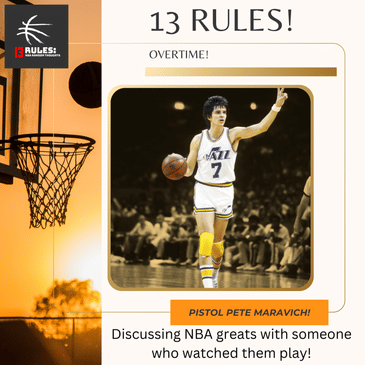

Join Jose Salviati, editor at ThePeachBasket.net, and longtime educator and athletic director Steve Purciello, as they dive into the incredible career of Hall of Famer Pistol Pete Maravich in the '13 Rules Random NBA Thoughts Overtime Podcast.' The hosts discuss what made Maravich unique, from his remarkable scoring ability in college to his innovative ball-handling skills that were ahead of his era. They also share personal memories of watching Maravich live and debate which modern player most resembles his style. Tune in to learn fascinating anecdotes about a player whose legacy continues to influence the NBA today.
00:00 Introduction to the Podcast
00:46 Spotlight on Pistol Pete Maravich
02:06 Pistol Pete's College Career
04:49 NBA Journey and Challenges
07:41 Memorable Moments and Legacy
13:55 Comparing Pistol Pete to Modern Players
20:37 Final Thoughts and Next Episode Preview
Powered by Beamly
Welcome to the best 15 minutes of NBA Random Thoughts online! Here, we dive into all things NBA with quick, thought-provoking insights that will keep you entertained and informed in just a short amount of time. From game recaps and player performances to trade rumors and latest news, we cover it all in this fast-paced segment.
Stay up-to-date on your favorite teams and players, and join the conversation by sharing your own random thoughts in the comments section. Whether you're a die-hard fan or just looking to stay in the loop, our 15 minutes of NBA Random Thoughts will provide you with a quick dose of basketball goodness that you won't want to miss. So grab your coffee, take a seat, and let's dive into the exciting world of the NBA!
[00:00:00] All right, it's time to talk off season. NBA basketball, Jose Salviati, editor at thepeachbasket.net, he's Steve Percello, a longtime educator, vice principal and athletic director, as well as a high school coach. Needed to add that because I think it's important.
[00:00:15] And this is the 13 Rules Random NBA Thoughts Overtime podcast. This is a show where we're going to discuss NBA stars from the 60s, 70s and 80s. These are players that you've probably heard about, but never got to see play. I really don't know a lot about them.
[00:00:31] That's what's exciting, right? What made these guys special? What player today most resembles that player and what is Steve's greatest memory about that player because Steve might have very well have seen those players live, which is pretty envious.
[00:00:46] Today we're going to discuss, I think the right way to say that is I'm pretty envious. Today we'll discuss Hall of Famer. Five time NBA All-Star, two time All-NBA first team player, 1977 NBA scoring champ whose numbers are retired with three different franchises,
[00:01:02] the Hawks, the Jazz and the Pelicans. Owner of one of the coolest nicknames in NBA history. We don't do cool nicknames anymore. We're talking about Pistol Pete Maravich. So really small. I just want to change some. Four times his number was retired. LSU retired it also. That's fair.
[00:01:20] That's fair. I did. Yeah. Yeah. Yeah. And I should have clarified that you're absolutely right. Yeah, that's, that's, that's, that's a special, special, special honor. This guy was, was special. He was unique. I think he was ahead of his time.
[00:01:31] I'm kind of excited to talk about this because I got to see the end of Pistol Pete's career. I remember he kind of rode the bench with, with the Celtics, the Larry Bird Celtics.
[00:01:42] So I got to see a little bit and even then you got to see some flashes right of, of who he was, but I didn't get to see prawn Pistol Pete. So definitely very excited to talk about him. Let's start like we have with what made him special.
[00:01:59] Why is it decades after he played that we're still talking about Pistol Pete Maravich, what made him unique? Well, let's start with college. He was the all time right now. He's the men's all time leading scorer. 3000 something points in college.
[00:02:16] They didn't have a three point shot then there was no shot clock. I mean, if there were a lot of things that, you know, also as a freshman, freshman couldn't play varsity basketball then. So he did in three years. Caitlin Clark is now the all time scorer.
[00:02:31] She just passed him, but this guy scored over 3000 points in three years. And it was ironic. He was a one man show. His team in college was really not a good team. I happened to see them in the NIT in 1970 and it was him with a
[00:02:47] bunch of guys playing basketball. But he just, he had his father was the coach, Prest Maravich. And he had pre wheel and people forget not only was a great shooter pre three point shot, he was a tremendous ball handler who was one of the first people
[00:03:03] to throw the ball behind his back, roll over his shoulder or do all those things that in that time was considered being the hot dog. I was going to say, didn't I get him benched? Not by his father. Who's right. I was not going to get him out.
[00:03:17] So if you ever get a chance, there's a movie on marriage and one of the sheens in it is they show dad driving the car and marriage his hand is out the door and he's dribbling the basketball as the car is moving.
[00:03:31] That was one of the things his father's grill did with him. All right. The movie and marriage. I believe in if you, his memoir came out, not his memoir, his autobiography came out 10 years ago.
[00:03:43] And I think they mentioned all that also about how the dad really drilled him and wanted his father drove him to be the player that he was. Pete's dad, one of those dads that drives you a little too hard. Right?
[00:03:58] We had the football player here in Oakland whose name sounded a lot like Maravich. I can't remember his name. Marinovich. Marinovich. Yeah. Yeah. Right. Right. Was that the same kind of overbearing dad is because I'd never heard that story before. That was a coach. Dad was his coach.
[00:04:14] Dad, I know he was he was an overbearing father. He pushed him beyond belief and Maravich was like, he was wrapped. He wasn't he was wrapped tight, meaning, you know, with things. So yeah, that probably did stress them from his, you know, from his dad. Yeah.
[00:04:31] But he was just way out of his time. I guess is the best way to put it. This is just college now coming out of college. Don't forget in this time, there were a lot of people who didn't like him
[00:04:43] because they thought he was a hack dog and a one man player and all. In college, they lost to the NITs. That's one of my first memories of them in the in the semifinals to Marquette who won the tournament.
[00:04:54] But then he came out and he went and he was drafted by the Atlanta Hawks, number three in the 70 draft, which is ironic because you would think a guy that great would be the first pick. What and two other people, one bad wiener who was great in college
[00:05:11] came before him at St. Bonaventure, but the other guy is a very interesting person, Rudy Tim Johnovich, who never had that kind of career, but he came second. And then Maravich was taken by the Hawks third marriage played for the Hawks for years, I believe.
[00:05:29] And in those four years, he scored 25 or so give or take, but the Hawks never took off. They never got better. So now we get the 75 and then the New Orleans Jazz are a new 74, 7, but with a new basketball team in the NBA.
[00:05:47] Now what better to draw people would be to get the LSU star who's having a rough time at Hawks. So they traded and got him now with the, and I was fortunate enough when we were at the Mardi Gras, I guess, 76 or 77 and they played in
[00:06:05] the Superdome then, and we saw a game with Pete Maravich in the Superdome. Yeah. Yeah. This was many, many years ago, but I recall that we were sitting real near the floor because the New Orleans Jazz didn't draw, so we were sitting
[00:06:24] near the floor and it just amazing to watch him. It was just a show. And they also had a guy by the name of Chuck Robinson, who was a pretty good player playing with them. But I remember that clearly. Didn't Danny Ainge bite him? Who?
[00:06:37] No, that was Tree Rollins. Oh, sorry. Chuck Robinson was a little before Danny Ainge. But anyway, New Orleans, and then he played there for a couple of years when the franchise decided they couldn't make it, they moved to Utah. Right.
[00:06:52] But, and he went there for a year or so and his knees began to go. And at that point, I believe they waved him. When he got waved, the Celtics picked him up and this was in Bird's first year, 1980, he played Bill Fitch was the coach.
[00:07:09] Bill Fitch and him didn't love each other. And next year, and Maravich had knee problems, so he was only going to be a smart player. But in 81, in the preseason, Maravich retired. Now the story was he couldn't play his legs and everything else, but
[00:07:25] there was always that thing out there that he and Bill Fitch didn't like each other, you didn't want to play for him because Bird loved them. Bird thought he was way ahead of his time and all that other, you know, all those other great things.
[00:07:39] But that was the end of the career. I have a lot of memories about Maravich when he was in his career. I can go back and as I just mentioned, we saw him in the Superdome. I remember that game.
[00:07:52] But the couple of things I remember, in 1970, I lived outside in New York and Jersey. And we went to Madison Square Garden because the NIT, all the games in the NIT back then were in the garden. So teams came to the garden and played.
[00:08:09] Now, before we get there, his senior year, they were 22 and 10. 22 and 10 today would be NCAA tournament team. They were second in the SEC. Back then, there were only 24 teams making the NCAA. Now, what is it? 48 or, you know, something. It's 64 now. So it's a little different.
[00:08:30] But we saw him play, we were in the garden. But back then, I don't remember, it wasn't sold out. But Maravich did draw a good crowd. We were able to run down as they came out for warmups and Maravich warmups were a thing that everybody talked about.
[00:08:46] Here's this kid with, I guess, long hair down above his ears, you know, to his ears, below his ears and straight, long hair, floppy. It's flopping all over. He's got these white socks he wore. They were like the old woollen socks.
[00:09:02] There he is right there in the picture. The old woollen socks and then floppy. Now it's a little different there. That's in the NBA, I believe. But in college, he wore the white socks and he was shooting laps. He was doing all kinds of things.
[00:09:15] And his warmup show was well known, like everybody wanted to see it. I don't remember we're on the baseline, you know, in the garden. And we were looking out on it, maybe 40 feet away. And it's like, oh my God.
[00:09:27] And, you know, I was one of my friends and we were both like, oh, this guy is just incredible. She'd have passing there and the things he can do and boy, he can shoot. But he was good. So that was my first memory.
[00:09:40] Now, about six years later, we did see him with the, in the, before that, we saw him play, I saw him in the Orleans. But then I remember in Jersey again, living in Jersey, we had a channel nine, which had the Knick games.
[00:09:58] And I remember Paul Frazier who I liked. He was a great player. Guarding him in a game, this is going to be in the winter in January, February, watching the game on TV. Marvish went for 68 and just annihilated wall Frazier.
[00:10:12] And don't forget again, I'm going to keep saying it. No three point shot. Yeah. So it's incredible. And as you can see with the film, look at him between the legs passes. That was on her it off back then. Right. Incredible player.
[00:10:26] I can't even like, like explain how good he was and how he shielded the passing again. It just, he was way ahead of his time, player ahead of his time. So, and let me, let me dig into that a little bit because we hear that a lot.
[00:10:41] But I think that's the edge. Was he the first guy to do these kinds of things? Today you see guys in the G league, you know, you get, you see every down again, you see someone try behind the back, nutmeg, whatever.
[00:10:55] But was he the first guy to really do this? Well, he was way ahead. Cousy was the first guy to go behind his back, but he was way ahead of everybody else, just the things he did with the passes over the shoulder, not
[00:11:06] looking, there's an example, the note work stuff and all the other things that just made players better on his team. Again, I'll go back to that college team. The team was terrible. They had one player, you know, and he carried them to the semifinals.
[00:11:21] And unfortunately at that time they couldn't get into the NCAAs, but, you know, so, so just the career and what he can do with a basketball is incredible, you know, it just, and there's nobody probably in our history that was as talented as him.
[00:11:41] Yeah, let's, let's dive into that a little bit. 44.2 points per game on average in college without a three point line. That's, that's staggering. Like how do you do that? I mean, that's, that's absolutely unbelievable. Was he, you know, you, you, you started off by saying, you know,
[00:12:01] he went third, this is a guy who averaged 44.2 and he went third. Because people thought he was a little bit of a ball hog, right? So I mean, I mean, he, the way he passed, the way he handled it.
[00:12:17] I don't understand why people felt that way about him. You know what I'm saying? I mean, I'm looking at a complete player. Basketball was completely different in that time. Yeah. There was more coach control and by coach control, I mean, there
[00:12:32] were set plays where there weren't a lot of options. You ran the playthrough. Now, if you watch, it's a lot of read or react the offenses, but also the, there were options and there were options all the things. There weren't as many. We get them.
[00:12:50] The UB Browns were becoming coaches and they were, he was a coach with the Kentucky Colonel's in the seventies, but those guys believed in really calling a play every time down the court and one of which taking away that individuality from the player. Right.
[00:13:06] Basketball was a completely different game. If you played like man, which you're trying to people would in the stands would call you a hot dog or just, you know, give you a hard time because that was not accepted.
[00:13:18] So it really like, it's something you have to understand basketball. The way it's played today was not the way it's always been played, I guess, or code. Yeah. No, I get that. Wow. Well, we talked about what made him special. You certainly brought up your favorite memory.
[00:13:36] I assume actually watching him play live, which is pretty spectacular. What we haven't touched on in, I know oftentimes this isn't a fair question to ask, we hate when we do it to new players, right? When a player is drafted and they say, oh, that's the next Michael.
[00:13:50] That's the next magic. That's the next whatever. We're kind of doing this in reverse. Who is today's pistol Pete Marovitch, right? Who most resembles his style of play? That's a difficult thing. I'll use with the ball in his hands, Nate Archibald when he started out
[00:14:07] with Cincinnati and that's going back. And his first coach was Bob Cousy, by the way. But he was like that. He led the league in points, assists. I mean, he just, you know, and he was a walking double double every night before double doubles were even talked about.
[00:14:22] But he was with the ball. But I don't think he was nearly as good a pure shooter as Marovitch. Marovitch can hit from anywhere. Long range anywhere. And I don't think, you know, Archibald doesn't fill that part in that time.
[00:14:37] Jerry West was a similar type shooter to him. We're at incredible range and incredible ability to shoot. And I always played with the Hawks. He's a great shoot. You know, that kind of player. But that was we're not getting a lot compared with anybody today, I guess.
[00:14:53] Yeah, the way to best describe it. You know, ironically, because I really want to put a name to somebody who's who's playing today and the only guy, the first guy who came to mind again, ironically, is an Atlanta Hawks.
[00:15:09] And that's Trey Young in terms of his ability to shoot from anywhere score does not have the handle, does not have, you know, I think the charisma or the ability. I mean, I've seen Trey make some nice passes before. I mean, does that bother you?
[00:15:22] Do you think Trey Young is maybe. He wasn't as good. But here's the thing about that. And it's very similar. Trey Young takes a beating in Atlanta because they don't win. Yeah, the English played in Atlanta.
[00:15:35] He took a lot of he and that's why they ultimately traded here because they didn't win. And that that I think is significant as a comparison Trey Young, he could play. I don't think he's near as good. And that's not a put down on Trey Young.
[00:15:53] A ball hand is marriage. Yeah, right. There's no like it's hard to explain how good a pastor you showed in the tape, but it's very difficult to explain. Now you take all that and make it a great shooter as well. And you realize how good he was.
[00:16:11] I mean, and I guess he played 10 years in the NBA. If you if in today's world. He would have played 13 years because he would have played his freshman year in college and then he would play three more years. Right. You know, his numbers would have gone up.
[00:16:27] Hall of Famer, all NBA number of times. I mean, it would it would have been even better than what it was. Though 40, 44 points a game in college. That'll never be never be surpassed. No, I don't see how he was unique.
[00:16:45] And we throw around the term ahead of his time a lot, I think. But this is the player who undeniably applies for. And this is the kind of guy that I think and I don't know that it's true of every player we'll talk about.
[00:16:59] But I think this is a guy who in his prong could be an impactful player in today's NBA. Do you think? Oh, yeah. Oh, yeah. I think the biggest argument would be, could he be part of a winning team?
[00:17:14] Yeah, that would be the biggest argument you might make about him because it didn't happen again. That was when Boston, you know, not Boston, but other teams like the Knicks and the Lakers were in their day and all that.
[00:17:25] So it was more difficult, but it still was, you know, it didn't it didn't equate to winning. Yeah, I'm looking at his career now. And yeah, his teams were are not good. And I believe the Hawke teams when he got drafted, they were pretty good.
[00:17:45] And I know if I remember correctly, but I believe there was a little resentment from the veteran players towards him. I believe they had Joe Colwell and Zell Mo Beatty and I think Bridges. And I'm going off the top of my head.
[00:17:59] Those three Hudson might have been I think he was with them. And those old time players didn't quite like marriage. And that didn't help the situation. And his first coach was Richie Guerin. Richie Guerin was a tough basketball player, played for the Knicks and the Hawks and all.
[00:18:16] But I don't know if they meshed real well. And again, that's just my chair. I don't know. Yeah, yeah, yeah. See, but that's the thing. It's not about right getting drafted. It's about getting drafted to the right team, too. I think that's so important.
[00:18:28] He played nine seasons with Atlanta and the Jazz, and he made it to the playoffs three times. That's just you know, that's not going to cut it, which, you know, it's unfortunate. I think if he was in a better place, I think we'd be talking.
[00:18:43] I mean, he's had he obviously career, dripping career. Top 75, top 50 NBA player. But he didn't he didn't come close to winning at all. I guess the biggest point in this. Not the biggest one of the bigger points would be in that time,
[00:18:59] the game and teams were coach dominated. Today, it's player dominated. And that is very important thing to understand. Coaches, people believe that the coaches can make a team win and so on. What we found out is get the most talent and you win.
[00:19:20] Yes. Or you're right there, I guess. Yeah. That reminds me, we'll finish on this note. Phil Jackson lost to Michael Jordan for three seasons or two seasons. And then he comes back and they put a mic in his face and they said, So what do you expect?
[00:19:34] Phil Jackson's straight face says, Well, I guess we're all going to score a few more points now. Well, it's right. He's like, well, you know what, as great as coaches, Jackson was when Jordan was gone for a year, year and a half.
[00:19:48] He came back for the second year with those two years. They didn't win it. They didn't win. Yeah. And you know, and then he had a tough time in the last year with one of those years with the Lakers, with them alone and all.
[00:19:58] They didn't do well either. So, you know, it did. It does come back to the talent. And this is the great circle of life, right? Who was the number one pick in Marinovich's draft? Rudy Tomjanovic, who was the coach of those Houston Rockets?
[00:20:11] Rudy Tomjanovic, certainly the number one pick. He was the number two pick. Oh, number two. Lanier was the first pick. Got it. Lanier was great. You ruined my story. Why would you do that? It's a great story. It's one of the things I try to do every week.
[00:20:26] He did it again. Forget facts. I just needed a good I needed a good story. Yeah, but it happened. My memories are too good. That's awesome. I appreciate that. All right, man, that's it. What a great time talking about Pistol Pete Maravich.
[00:20:40] This is a guy who, you know, and we didn't I was going to sign us off right now. But I but I got to say. Coolest nickname, one of the coolest nicknames in the history of the NBA.
[00:20:50] Pistol Pete is a nickname that I think I think it resonates. I think it's great. He's a shooter, right? I mean, I don't think he could fit today, right? They chase the bullets to the Wizards. Nobody's going to come out and call him Pistol Pete anymore.
[00:21:04] But one of the coolest nicknames in the history of the NBA, Barnard Pistol Pete Maravich guy ahead of his time. Let us know if you want us to discuss any particular player that you've heard of.
[00:21:13] Maybe you never got to see, you know, Steve got to see him or heard about him. We'd love to talk about your favorite player from the 60s, 70s or 80s. But until we hear from you, we're going to keep picking.
[00:21:26] And then next week, please join us on 13 rules over time when we discuss. The I forget, man, I believe the bill will bill Russell. Bill Walton. Oh, Bill Russell. That's what I wrote. Bill Russell, the 11 time champion. Yeah.
[00:21:45] I think we one of the greatest all around, meaning not just a player, just in life with what he did with the, you know, with the, with race and everything else. There you go. Player coach, 11 rings. That's the mic drop right there. All right.
[00:22:01] I got to just read what I wrote because I wrote Bill Russell and for some reason had a great part. When you get to be my age, you do it all the time. Well, on that note, we're going to sign off. Thanks so much for listening.
[00:22:12] We hope you find us next week when we talk again about the great bill Russell talk dance team. Thank you. Take care.