
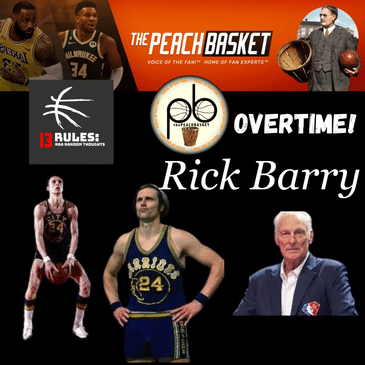

In this episode of 13 Rules Overtime, hosts Jose Salviati and Steve Purciello dive into the illustrious career of Rick Barry, an NBA and ABA legend. They discuss his unique free throw shooting style, his unparalleled scoring ability, and his impact on the game during the 60s, 70s, and 80s. The conversation also contrasts the fun and dynamic style of ABA basketball with the more traditional NBA approach of the time.
00:00 Introduction to 13 Rules Overtime and Rick Barry
01:08 Rick Barry's Basketball Career Highlights
03:28 Rick Barry's Scoring Prowess
06:21 Basketball During the ABA Era
04:03 Free Throw Shooting Technique
08:55 Rick Barry's Impact and Legacy
11:14 Player Comparisons and Modern Game
20:51 Conclusion and Next Episode Teaser
Powered by Beamly
Welcome to the best 15 minutes of NBA Random Thoughts online! Here, we dive into all things NBA with quick, thought-provoking insights that will keep you entertained and informed in just a short amount of time. From game recaps and player performances to trade rumors and latest news, we cover it all in this fast-paced segment.
Stay up-to-date on your favorite teams and players, and join the conversation by sharing your own random thoughts in the comments section. Whether you're a die-hard fan or just looking to stay in the loop, our 15 minutes of NBA Random Thoughts will provide you with a quick dose of basketball goodness that you won't want to miss. So grab your coffee, take a seat, and let's dive into the exciting world of the NBA!
[00:00:00] Alright, welcome to 13 Rules Overtime. It's time to continue. That's hot basketball during the NBA offseason. I'm Jose Solviati, editor at ThePeachBasket.net. He's Steve Prisciello, longtime educator, vice principal and athletic director.
[00:00:14] And this is the 13 Rules Overtime podcast. This is the show where we discuss NBA stars from the 60s, 70s and 80s. We talk about what made them special. What player most resembles that player today?
[00:00:30] What Steve's greatest memory about that player? Generally, we want to introduce you to players you've probably heard of as an NBA fan, but you didn't get a chance to watch play.
[00:00:39] Steve got to watch Rick Barry play. I got to watch him play a little bit at the end of his career. So I'll be able to add a little bit, at least my few thoughts that I had on him.
[00:00:47] But very, very excited to hear your thoughts on a great player who had, you know, I think the number one thing people remember him for is a free throw, but you know, which we'll certainly talk about. But he was more than that, right? He was a
[00:01:03] NBA champion, an ABA champion, an NBA Finals MVP, an eight-time NBA All-Star. We're talking about Rick Barry. All right, so let's start with Steve. Like we always do with these shows. Tell us about Rick Barry. What made him special?
[00:01:20] What was his game? What made him special out on the court? He could score. He's the all-time ABA leading scorer, the all postseason. I think he's the all-time postseason ABA scorer. He won two titles, as you said.
[00:01:36] One in the NBA, one in the ABA. Only four people have done that. One of them is Dr. J. But so, you know, an exclusive company, he won a title with the Oakland Oaks in the ABA. And an interesting trivia question to that. His coach was Alex Hannam,
[00:01:52] who won a title in both league. He won it with Philadelphia in the 67's when they stopped Boston's eight-year run. But he played for Oakland, then he played for the Washington. I guess it was the Bullets. Washington probably, the Washington Bullets back then.
[00:02:07] In 75, what's interesting on that is if you look it up, he averaged over well, over 20 points a game. But the rest of his team was about four. I think the next top scorer was either Jamal Wilkes or Butch Beard at 14 points. And they swept the Bullets out.
[00:02:25] The Bullets had a couple of guys you might have heard of. Wes Unsell, Elvin Hayes, Phil Cheneer. So, you know, it's a tremendous upset. I remember correctly they were considered no chance to win that playoffs series. And they
[00:02:41] wind up sweeping them, I guess momentum. And they just got on a roll at the time. So it was another incredible thing. I said, but he led the NCAA, NBA, ABA and scoring. There's so many different things. As I said, he, you know, three, him and three,
[00:03:01] four guys made the one of the titles. My memory is 19. I remember, I guess it would be 72. I kind of love the Nets. And they had this coach you might have heard of,
[00:03:12] Luke Cornus second, who was in between going back to St. John's. But they had, and I'd watched them on local TV. It was on Channel 9 back in Jersey. The Nets, they had this guard I just fell in love
[00:03:25] with from South Carolina. John Roach, I thought he was great. But Barry was on that team. They went to the finals in the ABA in that year. And they lost in the finals, I believe to
[00:03:34] Denver and Sext. But between them two, they were just incredible. They also had Billy Melchione, who's another guy in one titles in both leagues. So they, they were just fun to watch. The thing about Rick Barry, I think I told you this before, but when I was younger,
[00:03:51] I played in Biddy League in law. We were small. And the foul shot was maybe a foot in from the foul line. So it was 14 feet. And everybody struggled. We were small and struggling to
[00:04:02] shoot it. So Rick Barry shot the ball from between his legs under him. Yeah. What you don't see it, you don't never see it again. But everybody, all these smaller players in that league and Biddy League, I was shot the ball under him because that was easy. But
[00:04:22] also we saw Rick Barry do it. You didn't see a lot of games. You only saw maybe the game in a week and things like that. Some of the finals and things, but you didn't see a lot.
[00:04:33] But when you saw him, you just saw a guy that can score. It was just incredible to watch him. I remember in the playoffs in 72 where he would just go off in some games
[00:04:45] and carry the team to win. And it was like, wow, this is, this is, you know, it's just so much fun to watch. Yeah, all they be a fan. There's so many things about him that were incredible, incredible, you know, his career,
[00:05:01] as I said, the two titles are just, you know, it's really fast with the Oakland Oaks. But what really stunned me about the second title was the fact that he was scoring a lot of points. Nobody over 14 points again, not signed him on that team. Think about that.
[00:05:20] In today's NBA, you've got to have at least two or three guys in your 20. Do that. And he, you know, he just carries. Now I've heard you talk about the ABA a lot and you always
[00:05:33] throw in the word fun. Right? It was fun basketball to watch. And, you know, having, you know, I'm an 80s Lakers guy. And to me, that was the epitome of fun professional basketball. Right? Magic Johnson, Showtime. That was fun basketball. Then you kind of
[00:05:51] transitioned to 90s and 2000s. You got Shaq and Kobe, which was winning basketball, but it wasn't fun to watch. I mean, admittedly, it really was not very fun to watch. It was poor, pounded out, you know, the occasional dunk. But getting raised on Magic Johnson's
[00:06:08] passes and Kareem's hook and just the magic of not the Magic Johnson, but the magic of that style of play. I got to know that's my fun basketball. What made the ABA fun? Well, before we
[00:06:21] do, I just want to remind you my favorite year in the 80s was 84. I believe Boston beat the Lakers in seven. But but going back to the ABA, they used a red, white and blue ball, which was fun.
[00:06:35] Because if you see a rotate, it was just fun to watch it. And the NBA didn't come into this with the three until 80 or 81. The ABA had the three. Yeah, it was fun. It was just it was fun
[00:06:49] to watch. Plus, the ABA had a lot of guys that were off beat and I'm thinking of Marvin Barnes right away. But Marvin Barnes took off beat a little too far, didn't he? He did. But
[00:07:03] personalities, I think the NBA, the 70s in the NBA were really a time where the NBA was down. People were down on it. That was a time when it was look, you had to have at least or you
[00:07:17] could only have a couple of black players on a team and they they they were really, you know, it was a bad time in the NBA. And it wasn't it wasn't nearly what it is today. So, you know, and the
[00:07:29] ABA was just more wildly sort of like if you want to compare the AFL and the NFL back in their time in the 60s, the AFL was fun. They threw the ball all over the field and the ABA was fun. They
[00:07:43] shot threes, they ran. It was a different camp. You hit on something before. The NBA at the time was more or less a half working. And then it wasn't great, great fun to watch where the ABA
[00:07:56] was just wide open basketball. You mentioned, you know, I'm only going to bring it up because you did. You mentioned 1984. I'm just taking a look. There was 1985, 1987, 1988 and 1989. Well, those were years that Boston didn't win at all. I kind of was not what fallen basketball
[00:08:18] those years. So, wow, that's good. I'm glad, you know, they won quite a few, quite a few in the 80s. That was my fun basketball. But I definitely get it. I, you know, I hear stories about the ABA, the multicolored ball and, you know, the fact that
[00:08:36] they were willing to experiment, right? Three point, well, three point line. I thought it originated there. It didn't. But, you know, at least they had it. What made Rick Berry kind of getting back
[00:08:47] to the, to you on to the topic? What made him special in the NBA and in the NBA? In change? No, he could just score. He did just, he just had an incredible
[00:08:59] net to score. The other thing too that was interesting about him and he did it on the quarter. He wasn't happy with mediocrity. And you could see some of the things and,
[00:09:12] you know, and I know he wasn't well loved among the NBA and people because of that. But he just was, he was just an intense foreign player. And by the way, three or four of his kids
[00:09:24] at the point in the NBA is right. Right. And I was you a little bit about the gene pool, I guess, lack of a better way to put it. Just his number 24 was retired by by the Warriors by Miami
[00:09:40] of the University of Miami were. So, you know, he was this great guy that a lot of people don't know a lot about and did a lot of tremendous things. And I think I think he did the NBA games.
[00:09:55] He did do the NBA games on TV. He was one of the early color men on those games. I believe he worked for TNT also doing games going back. So, so he was, you know, he was
[00:10:07] this person that was everywhere back then and just, you know, just, just, just great to watch. I mean, I keep going back to that 72 team. What fun, what pure fun. Billy Melchione
[00:10:19] on that team as well as the Whopper pulse who played for them, St. John's tie in with Carter second. But they were just fun to watch with John Roach. And it was just at the time and
[00:10:33] the Knicks were still good. If I remember correctly in the New York area, then that's where the story was because of their just it was just fun. It was just I can't say it in another way, but you look forward to watching the playoff games. Right. Right.
[00:10:48] Well, this is my favorite part of this particular conversation because it's hard for me to envision a player I never saw play. So I got to ask you, Rick Berry just he sounds like a bucket. Right. He sounds like a guy who, you know,
[00:11:01] who's a winner, a dog. Somebody who's going to go out there and take and make the big shot. Who most resembles that style of play? That's what it was somebody playing today. It's a good question. It's a tough answer. I'm going to say in a lot of ways,
[00:11:20] not the moon with George Curvin who could score just a great score. Yeah. Yeah. Different in the way they scored, but they can both were great, great scores. He would you know, he would probably be I'd have to think deep about somebody else who just was a
[00:11:38] score. Bernard King, Adrian Dantley. Bernard King more of a post up guy that would turn around and had that little turnaround that was unstoppable. Dantley for six four was tough in the post and he could do things in the post with Barry necessarily go there.
[00:11:54] So Barry was more of a mid range guy, even though he was tall. Not that a bad skidding. You just do. And the thing is don't bow him because you'll kill the other power. Right. Right. Right. Right. Right. Yeah. We'll talk a little bit about that.
[00:12:06] So I'm trying to figure I mean I'm trying to put somebody in today's game. How about Kevin Garnett? Does that? No. That was more Kevin Garnett was don't forget the defensive player deep.
[00:12:19] All right. Kevin Garnett. I think his value to a team was other things and Kevin Garnett would be the antipasist. Kevin Garnett was always worried about team success. It's been reputed that Barry
[00:12:32] wasn't always worried team success. Gotcha. Gotcha. Check out there. I mean the opposite in a lot of ways. It's hard to even think of anybody that would score is great score. Not one.
[00:12:47] Garland, Thinnytown. I don't want I don't want to I don't want to. You don't want to disparage Kat. I get that. No. Yeah. Yeah. That would be a nice way to put it. Yeah.
[00:13:00] Well I mean you could cat I think of a scorer who did you know he may not you know he's you know you question whether he plays for the stats or plays for the team. He wasn't
[00:13:10] that wasn't as good as you know there's not even a comparison to be true. It's again and just and I said it before to understand how great he was. Think about a team that wins
[00:13:23] the playoffs finals four zero. This guy on that team averaged a lot of points over well over 20 25 30. I know the next player on was T had 14. I believe it was either butch beer or Jamal. Well
[00:13:41] now butch beer was a journeyman type. He that was his prime. He played with a lot of teams in his years. The next one of them you know he had never coached as well when college and the pros
[00:13:56] but but the point being which was not a great player and that was there. It's when they had Clifford Gray and George Johnson. They played center and he was in her out with two and a half but for Ray was a defender. George Johnson could shoot a little
[00:14:12] but he wasn't great so they didn't have a deep really good team and they went through it. It was it was remarkable to watch and that was Barry's ability to to carry a team. I mean he just
[00:14:26] carried as he as he did a few times with the old quarter and teams like that. So you know it's very difficult to look at somebody in modern basketball. You don't find one guy carrying
[00:14:40] a team like right. Right. Yeah. This game was changed. I guess it is game you know in different ways of scoring but Brunson where he's one man shell carrying the team. There you go.
[00:14:53] Not did play the same on the court. Right. Right. Yeah. Yeah. And I think Rick Berry had a you know about half a foot on on Brunson as well. Rick Berry's free throw shooting
[00:15:03] unbelievable. I went down the the rabbit hole. He led everyone in free throw percentage seven times in his career with a high this is this man of 94.7 so he shot 95 percent in the 78 79 season. That means he missed 10 free throws all season long. That's unbelievable and you talked about
[00:15:26] his free throw shooting. You talked about looking at it as a kid and emulating it. I got a video I want to show you but I gotta ask why when you've got something that's proven here's a guy
[00:15:39] who did it his entire career. He shot 35 percent. This is a proven process. It works. How come nobody has done it since then how come probably nobody ever will crazy thought basketball is a macho
[00:15:58] type shooting the ball like that isn't macho so nobody would want to do that. I know when Shaq was playing some power right rock and I heard about this. Yeah. Shaq wouldn't even figure it.
[00:16:15] And Kareem tried to talk him into a hook and he said I don't need no hook. He made a rap song about it. Well yeah and the thing about like guys like Shaq struggle will chamber and struggle
[00:16:26] shooting foul shots because what they say is their knees. They can't really bend and so hands are hand or two big. It was always stiff without a lot of guys up his hands
[00:16:36] and made them. But with the point being the bending when he's shooting to get his legs into it and they said that those guys big guys always had trouble with their knees and everything else and then we'll shoot them underhand. Wow. Didn't have success either way.
[00:16:52] Well he really so it's not proven. It doesn't work for everybody. Well I would think well if you ever listen to Barry talk you understand he's a perfectionist. Right. My sense would be
[00:17:07] that he worked his ass off trying to become this you know this is right. You know what and thinking about that his personality I think would be similar to Jerry West not the game similar meaning in
[00:17:21] that perfection. Great segue to this video. Let's hear Rick Barry talk about his free throw shooting style and there's a really neat turn on one of caught in the open. A subpar great video. Now we have Rick Barry the great great forward from the Golden State Warriors
[00:17:43] started by Jamal Wilkes another great off-top from the Golden State Warriors. They can break him just been fouled. Now what do you do. Well Rick first thing I try to do is get a comfortable position with my feet spread and
[00:17:56] try to get as relaxed as possible. I think that's the big key to shooting free throw so that you feel completely relaxed and of course with my two handed underhanded free throw it's a lot easier
[00:18:04] I feel to get in a relaxed situation. I like about the ball three times that relaxed right three times not two or not four. I talked to you about this before. That's Ren Arbeck's personality man you could tell he was just that was a fair question
[00:18:21] but I love the way he didn't just ask you. One or two one or four. He was a funny guy. He was he was a bull in a check and shop. He would stay and do whatever he wanted in
[00:18:33] care cool you. He was an interesting man and he's why there's 18 titles in Boston. There you go. There you go. Let's watch his free throw and then we'll wrap up.
[00:18:46] Well I haven't been going at three times and I just do it the same way. I hold the ball in exactly the same position on the ball every time and I think repetition in this game is really
[00:18:55] a key to this. Listen to this. It's a super pressure. I think it's okay. No way. Moundryer. So become something that is better than your mind. All right. He asked is it repetition or superstition? That's great. That's a great question.
[00:19:11] Pre-pound this. Arms hang down. My knees have been relaxed. Top of the wrist. Battle through. All right. Now that's wild. Did you ever shoot him underhand? As a kid. Yeah. And the bitty leagues that would play it in. You know everybody
[00:19:29] did it because he did it when we were kids. So you do it. The thing I keep harping on is there's two things I want to make. First point I wanted to make about Rick Barry. He was
[00:19:39] ahead of his time also. He used the ABA to make more money. I believe he had a shun out a year because of contract problem but anyway, but he used the ABA in other words he was jumping back and
[00:19:50] forth. He went from MBA ABA back because of the money. He was ahead of his time because back then it wasn't free agency. It's the only agency. The only chance you have is to go to the
[00:20:03] other league and he did it and that helped him make more money. So if you think about the modern player, he's way, way ahead of his time. That's something that's also very interesting about him.
[00:20:17] So and going back to what you asked, yeah we all did when we were kids because that's what he did. So we tried we tried to do it. And by the way that was Redd on Roundball who back in
[00:20:29] whatever year it was, he did these little clips every during televised MBA games at half time and it was great. It was great to watch probably the best coach ever and probably from the best
[00:20:42] organization ever so it was good to see you all then. Probably. No I think definitely. We'll leave it on that note then. That's it. Hope you enjoyed learning about Rick Barry.
[00:20:55] I did. I love going down the rabbit hole. Hearing about a player who missed 10 free throws all season long is unbelievable. That's just it's mind-boggling. Let us know who you want us to talk about.
[00:21:07] We've got so many players to choose from right now we've got one on deck that I'm excited about. Join us but again we want to hear from you of course if you've got somebody
[00:21:17] that you think you'd like to hear a little bit more about but next week of 13 Rules Over Time we're going to discuss the great pistol Pete Marevich. Really really excited to talk about pistol Pete next week. We'll talk again Steve thanks. Thanks.